40 inches is exactly 3 feet 4 inches (3’4″) tall, or 101.6 centimeters. That’s approximately 3.33 feet in decimal form and just 1.6 centimeters taller than one meter.
To visualize this height, picture a standard meter stick standing vertically with another 1.6 centimeters added to the top. That’s almost exactly how tall 40 inches is.
Forty inches can describe a person’s height, a piece of furniture, or the length or width of a household object. Below are practical size comparisons, exact conversions, and simple ways to measure 40 inches.
How Tall Is 40 Inches in Feet?
40 inches equals exactly 3 feet and 4 inches, or 3⅓ feet (approximately 3.33 feet).
Since one foot contains 12 inches, divide 40 by 12 to convert the measurement into feet:
40 ÷ 12 = 3.333… feet
This gives three complete feet with four inches remaining.
Here are the exact and rounded conversions:
| Unit | Equivalent of 40 Inches |
|---|---|
| Feet and inches | 3 feet 4 inches (3’4″) |
| Decimal feet | Approximately 3.33 ft |
| Fractional feet | 3⅓ ft |
| Centimeters | 101.6 cm |
| Meters | 1.016 m |
| Millimeters | 1,016 mm |
| Yards | Approximately 1.11 yd |
These conversions follow the standard relationship of 1 inch = exactly 2.54 centimeters.
Forty inches are also eight inches shorter than four feet (48 inches), making the difference easy to understand when comparing heights.
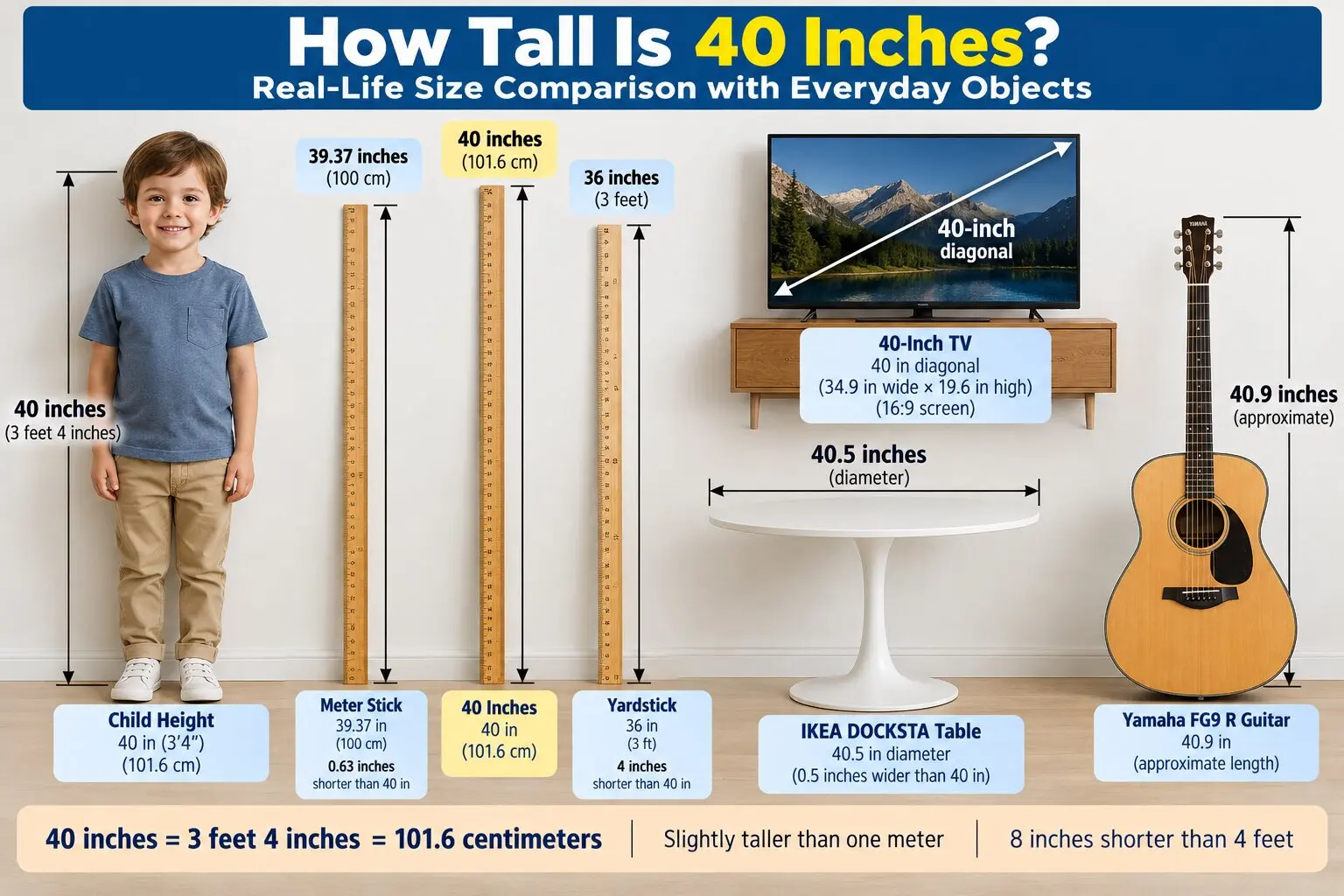
What Does 40 Inches Look Like in Real Life?
The easiest way to understand 40 inches is to compare it with familiar measurements and objects.
Some references are exact, while others provide close approximations of the same height, length, width, or diagonal.
| Object or Reference | Measurement | Comparison |
|---|---|---|
| Meter stick | 39.37 inches | About 0.63 inches shorter |
| Yardstick plus 4 inches | 40 inches | Exact |
| Two 20-inch lengths | 40 inches combined | Exact |
| 40-inch television | 40-inch screen diagonal | Exact diagonal measurement |
| IKEA DOCKSTA tabletop | 40.5-inch diameter | 0.5 inches wider |
| Yamaha FG9 R acoustic guitar | Approximately 40.9 inches long | About 0.9 inches longer |
These comparisons are useful, but remember that a product’s width, height, diameter, and diagonal are different measurements.
1. A Meter Stick
A standard meter stick measures 100 centimeters, equivalent to approximately 39.37 inches.
That makes it only 0.63 inches (1.6 cm) shorter than 40 inches.
If you have a meter stick at home, school, or work, it provides one of the closest standardized references for understanding this measurement.
Stand it vertically to picture a height of 40 inches, or place it horizontally to estimate the length.
Because the difference is small, a meter stick is a particularly convenient visual reference when you don’t have an inch ruler available.
2. A Yardstick Plus 4 Inches
A yardstick measures exactly 36 inches, equivalent to 3 feet.
Adding another four inches creates a total length of 40 inches (101.6 cm).
This is a straightforward way to measure the distance using ordinary measuring tools.
For example, place a yardstick along a wall, mark the end of its 36-inch length, and measure another four inches from that point.
If you want a smaller reference for the extra distance, see our guide to things that are 4 inches long.
This method is particularly useful when checking furniture dimensions or measuring vertical space.
3. Two 20-Inch Lengths
Two lengths measuring exactly 20 inches each create a combined distance of 40 inches (101.6 cm) when placed end to end without gaps or overlap.
This is useful when measuring furniture, checking wall space, or comparing objects larger than a standard ruler.
If you’re familiar with how long 20 inches is, simply picture that measurement doubled.
You can also mark a 20-inch distance twice along the same straight line to measure the full 40 inches.
4. A 40-Inch Television Screen
A television advertised as 40 inches has a screen measuring 40 inches diagonally, from one corner to the opposite corner.
That does not mean the television is 40 inches tall or wide.
For a standard 16:9 display, the visible screen area measures approximately:
34.9 inches wide
19.6 inches high
40 inches diagonally
These figures exclude the television’s bezel, frame, stand, and other external components.
A 40-inch TV is therefore a useful reference for diagonal length, but not for a 40-inch vertical height.
5. A Round Tabletop About 40 Inches Across
The IKEA DOCKSTA round table has a listed tabletop diameter of 40.5 inches, making it just half an inch wider than 40 inches.
This provides a practical horizontal comparison for visualizing the measurement.
The diameter runs straight across the center of the tabletop, from one outer edge to the opposite edge.
Importantly, the tabletop’s diameter is different from the table’s height above the floor.
Because product dimensions can vary by model or market, check the current specifications when using a particular table as a measurement reference.
6. A Full-Size Acoustic Guitar
Some full-size acoustic guitars measure approximately 40–41 inches from the bottom of the body to the top of the headstock.
For example, Yamaha lists the FG9 R acoustic guitar with an overall length of 1,039 millimeters, or approximately 40.9 inches.
Standing a guitar of this size upright provides a useful visual comparison, as it is less than 1 inch longer than 40 inches.
Guitars vary in shape and dimensions, so not every full-size acoustic guitar has the same overall length.
Also, the guitar’s total length is different from its scale length, which describes the vibrating length of its strings.
How Big Is 40 Inches Compared to a Person?
If you’re imagining a height of 40 inches, picture someone standing 3 feet 4 inches (101.6 cm) tall.
Some young children reach this height, although growth varies significantly, so a child’s age alone is not a dependable measurement reference.
For many adults, a point 40 inches above the floor may fall around the hip or waist area, but the exact position depends on body height and proportions.
If you need to check someone’s height or determine whether furniture will fit, measure vertically from the floor rather than relying on body-part comparisons.
Also remember that an object measuring 40 inches wide is not necessarily 40 inches tall. Always check which dimension is specified.
How to Measure 40 Inches Without a Tape Measure
You can measure 40 inches using a yardstick, meter stick, or ordinary school ruler.
1. Use a yardstick. Measure the full 36-inch length, then add four inches with a ruler.
2. Use a meter stick. Measure 100 centimeters, then add 1.6 centimeters.
3. Use a 12-inch ruler. Measure three full ruler lengths to reach 36 inches, then add another four inches.
4. Use two verified 20-inch lengths. Align them end to end without gaps or overlap to create a 40-inch reference.
When measuring vertically, keep the tool straight and aligned with the starting point.
For furniture purchases, cutting materials, or checking whether an object will fit, use an accurately marked measuring tool rather than relying only on visual estimates.