50 feet equals exactly 600 inches, 1,524 centimeters, or 15.24 meters. That’s the full width of a regulation NBA basketball court.
To picture this distance, imagine looking straight across a basketball court from one sideline to the other or stretching a 50-foot garden hose along the ground in a straight line.
The comparisons below use verified official dimensions, published product specifications, and exact measurement calculations. They also show how to estimate or measure 50 feet in everyday outdoor spaces.
How Many Inches and Meters Is 50 Feet?
Fifty feet equals exactly 600 inches or 15.24 meters. Since one foot contains 12 inches:
50 × 12 = 600 inches
Here are the equivalent measurements:
| Unit | 50 Feet Equals |
|---|---|
| Inches | 600 inches |
| Centimeters | 1,524 cm |
| Millimeters | 15,240 mm |
| Meters | 15.24 m |
| Yards | Approximately 16.67 yards |
| Miles | Approximately 0.00947 miles |
Fifty feet is just 24 centimeters longer than 15 meters.
It’s also five times the length of 10 feet and ten times the length of 5 feet.
What Does 50 Feet Look Like in Real Life?
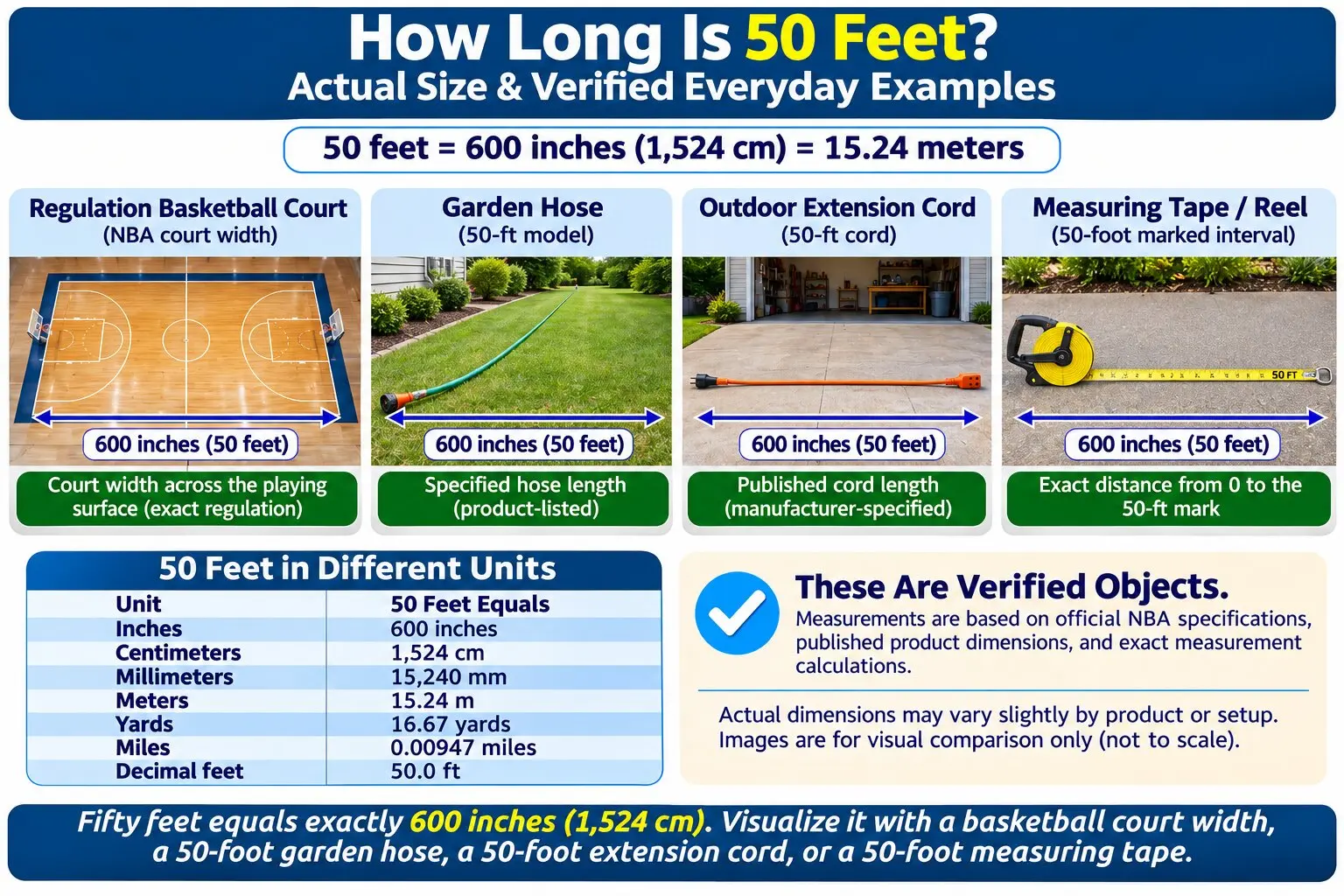
Fifty feet is a substantial distance compared with most household objects. A full-size basketball court, garden hose, or outdoor extension cord provides a more useful visual reference than smaller everyday items.
Here are five practical comparisons:
| Object or Reference | Documented Measurement | Comparison |
|---|---|---|
| NBA basketball court | 50-foot playing-court width | Exact regulation size |
| Non-expanding garden hose | 50-foot listed length | Product-specified |
| Southwire extension cord | 50-foot listed cord length | Manufacturer-specified |
| Measuring tape or reel | 50-foot marked interval | Exact measuring reference |
| Five 10-foot measured sections | 50 feet combined | Exact when measured correctly |
These are verified references based on official NBA specifications, published product dimensions, and exact measurement calculations.
The manufactured products were not independently physically measured for this article. Their listed lengths are useful references, but actual dimensions may vary within manufacturing tolerances.
1. The Width of an NBA Basketball Court
A regulation NBA basketball court provides one of the clearest examples of a 50-foot distance.
According to the NBA’s official specifications, a basketball court measures 94 feet long and 50 feet wide.
That means the distance across the playing surface from one sideline to the opposite sideline is exactly 50 feet.
Imagine standing at the edge of a basketball court and looking directly across its width. That entire horizontal distance represents 50 feet.
The court’s length is considerably greater at 94 feet, so the comparison applies specifically to its width.
This is a dependable reference because the dimensions are established by official sporting regulations rather than estimated from an everyday object.
2. A 50-Foot Garden Hose
Garden hoses are available in several lengths, including 50-foot models.
For example, Home Depot lists a non-expanding garden hose, model OHSA05232, with a specified hose length of 50 feet.
Imagine connecting the hose to an outdoor faucet and laying it along the ground in a straight line.
Its published length provides a practical reference for how far 50 feet extends across a yard or driveway.
However, a hose that’s coiled, bent, or routed around obstacles won’t provide 50 feet of straight-line separation between its endpoints.
For the clearest comparison, use a non-expanding hose and straighten it without applying excessive tension.
The manufacturer’s specified length is a useful estimate, although fittings and manufacturing tolerances can affect the actual end-to-end measurement.
3. A 50-Foot Outdoor Extension Cord
Outdoor extension cords are also available in specified 50-foot lengths.
For example, Southwire manufactures its Royal 12/3 SJOOW extension cord, model 3688SW0002, with a published cord length of 50 feet.
This provides another practical reference for visualizing a long distance.
Imagine laying the cord straight across an outdoor workspace, without stretching or pulling it tightly.
Its listed cable length represents approximately 50 feet, although the complete physical distance including connectors may differ.
The cord’s actual reach also depends on its routing and the slack needed for safe use.
An extension cord should not be stretched under tension or used beyond its rated electrical capacity.
This example is useful for visualizing distance, but a measuring tape remains the better choice when precision matters.
4. A 50-Foot Measuring Tape
A measuring tape or surveyor’s measuring reel provides the most direct way to see the actual length of 50 feet.
Extend the tape along a straight surface from its zero point to the 50-foot mark.
On an accurately marked measuring tape, that distance equals exactly 50 feet.
You can use this method to measure the length of a garden, driveway, outdoor activity area, or other open space.
Unlike comparisons based on manufactured products, a measuring tape is specifically designed to measure the distance between two points.
For accurate results, keep the tape straight, follow the tool’s instructions, and make sure the zero point and endpoint are correctly aligned.
How Many Steps Does It Take to Walk 50 Feet?
The number of steps required to walk 50 feet depends on your step length.
For example:
| Assumed Step Length | Steps for 50 Feet |
|---|---|
| 2 feet | 25 steps |
| 2.5 feet | 20 steps |
| 3 feet | Approximately 17 steps |
These are calculated examples, not fixed walking averages for everyone.
If each step covers 2.5 feet, walking 20 steps would cover approximately 50 feet.
To make your own estimate more accurate:
Measure a short distance along the ground.
Walk that distance at your normal pace while counting your steps.
Divide the measured distance by your step count to estimate your average step length.
Divide 50 feet by your estimated step length to find the number of steps needed.
Walking can provide a rough distance estimate, but the result varies with pace, stride, and terrain.
For property measurements or other tasks requiring precision, use a measuring tape.
How to Measure a 50-Foot Distance
You don’t need a measuring tape that extends the entire 50 feet in one section.
You can combine smaller, accurately measured intervals to reproduce the distance.
Five 10-foot sections: Measure ten feet five consecutive times along one straight line.
Ten 5-foot sections: Mark ten consecutive intervals of five feet each.
A 50-foot measuring reel: Extend it from zero to the 50-foot mark.
A non-expanding garden hose: Use a specified 50-foot model as an approximate visual reference.
A basketball court: Use the regulation 50-foot width as a reference when the court is accurately marked.
For example, five consecutive ten-foot measurements make exactly 50 feet:
10 + 10 + 10 + 10 + 10 = 50 feet
Alternatively, ten accurately measured five-foot sections produce the same distance.
Make sure each measurement begins where the previous one ends and that all sections follow the same straight line.
For installations, property planning, or construction tasks, use an accurate measuring tool rather than relying on estimated household dimensions.
Why a 50-Foot Hose May Not Reach 50 Feet Away
A garden hose labeled 50 feet has a specified length, but that doesn’t guarantee it will reach a location 50 feet away under every condition.
The main difference is between straight-line distance and the route the hose follows.
For example, a hose may need to bend around a wall, travel along the edge of a garden, or leave additional slack near the faucet.
These bends and changes in direction increase the length of the route compared with the direct distance between the starting point and the destination.
A 50-foot hose can therefore require more length than its label suggests when navigating obstacles.
The same principle applies to extension cords and other flexible equipment.
When planning a hose or cable route, measure the actual path it needs to follow, including any necessary slack, rather than only the straight-line distance.