One foot (1 ft) equals exactly 12 inches, 30.48 centimeters, or 304.8 millimeters. To picture this length, imagine a standard 12-inch ruler, one side of a 12 × 12-inch sheet of scrapbook paper, or two US dollar bills placed end to end.
A foot is a common unit of length used to measure furniture, shelves, flooring, and household spaces. Although the conversion is simple, understanding what one foot looks like can be helpful when you don’t have a measuring tape nearby.
Below are everyday comparisons based on verified published dimensions, official measurement standards, and clearly identified approximations. You’ll also learn how to estimate a foot-long distance using familiar objects.
How Much Is One Foot in Inches and Centimeters?
One foot is exactly 12 inches or 30.48 centimeters. It’s also one-third of a yard.
Here are the conversions into other common units:
| Unit | 1 Foot Equals |
|---|---|
| Inches | 12 inches |
| Centimeters | 30.48 cm |
| Millimeters | 304.8 mm |
| Meters | 0.3048 m |
| Yards | ⅓ yard |
| Decimal feet | 1.0 ft |
The foot is a standardized unit of length commonly used in the United States. Its abbreviation is ft, while the prime symbol (′) can also represent feet.
For example, 1 ft, 1′, and 12 in all describe the same distance.
According to the National Institute of Standards and Technology (NIST), the international foot is defined as exactly 0.3048 meters.
What Does One Foot Look Like?
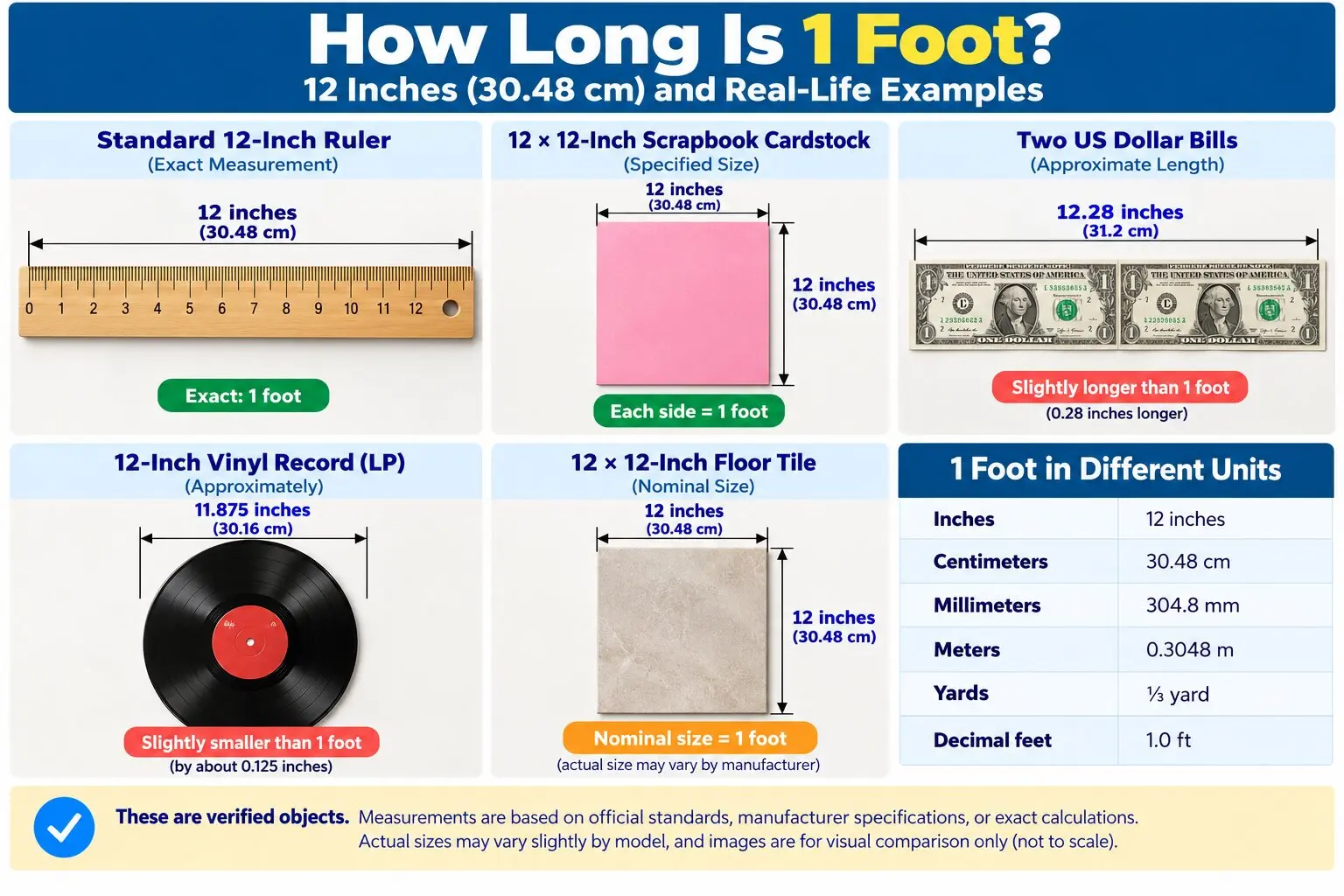
Imagine placing a standard 12-inch ruler horizontally on a table. The measured distance from its 0-inch mark to its 12-inch mark is exactly one foot.
You can also visualize this distance using a square sheet of scrapbook paper measuring 12 inches on each side or a full-size vinyl LP with a diameter slightly smaller than one foot.
Here are five useful comparisons:
| Object or Reference | Documented Measurement | Comparison |
|---|---|---|
| Standard measuring ruler | 12-inch marked interval | Exact |
| 12 × 12-inch scrapbook cardstock | Nominal 12-inch side | Specified size |
| Two US dollar bills | Approximately 12.28 inches combined | 0.28 inches longer |
| Full-size 12-inch vinyl LP | Approximately 11.875-inch diameter | Slightly smaller |
| 12 × 12-inch floor tile | Nominal 12-inch dimensions | Actual size varies |
These examples use official measurements, manufacturer-listed dimensions, and established product specifications.
The term verified refers to dimensions supported by published sources rather than independent physical testing. Nominal product measurements may differ slightly from the dimensions of individual manufactured objects.
Everyday Things That Measure About One Foot
1. A Standard 12-Inch Measuring Ruler
A standard 12-inch ruler is the clearest physical reference for one foot.
Its marked scale runs from 0 to 12 inches, giving a measurement of exactly 30.48 cm.
Place the ruler on a flat surface and observe the distance between those markings. You can use it to picture a foot-long section of a shelf, tabletop, or wall.
For accurate measurements, start at the zero mark rather than assuming the ruler’s physical edge aligns perfectly with zero.
This is the most dependable reference because it shows the measurement directly.
2. A 12 × 12-Inch Sheet of Scrapbook Cardstock
Square scrapbook cardstock is commonly sold in a 12 × 12-inch format.
For example, Cricut offers cardstock sheets with specified dimensions of 12 inches wide and 12 inches long.
That means each nominal side measures exactly one foot.
Imagine placing a square sheet flat on a desk and measuring along one edge. Its width provides a familiar visual reference for 12 inches.
Because the paper is square, you can also rotate it to visualize a one-foot height.
The stated dimensions describe the product’s nominal size. Individual sheets may have small manufacturing tolerances.
3. Two US Dollar Bills Placed End to End
Modern US dollar bills measure approximately 6.14 inches long and 2.61 inches wide, according to the US Currency Education Program.
Place two bills end to end along their longer edges without leaving a gap.
Their combined length equals:
6.14 + 6.14 = 12.28 inches
That’s only 0.28 inches (approximately 7.1 mm) longer than one foot.
This makes two dollar bills a useful comparison when you’re trying to estimate a foot-long distance without a ruler.
The bills must be aligned in a straight line. Stacking them or placing them along their shorter edges produces a different measurement.
4. A Full-Size 12-Inch Vinyl Record
A full-size vinyl LP provides a familiar circular comparison for one foot.
Although commonly called a 12-inch record, its actual outside diameter is generally slightly smaller.
Published record-manufacturing specifications give a standard nominal diameter of approximately 11.875 inches (30.16 cm).
That’s about one-eighth of an inch shorter than a full foot.
Imagine placing the record flat on a table and measuring straight across its circular surface through the center.
That diameter provides a close visual reference for one foot.
The measurement describes the record’s outside diameter, not its thickness or center label.
5. A Nominal 12 × 12-Inch Floor Tile
Floor tiles are commonly sold in nominal 12 × 12-inch sizes, especially for kitchens, bathrooms, and other tiled areas.
A square tile of this stated size provides another way to visualize a foot-long distance.
However, not every tile sold as 12 inches measures exactly that width.
Some have smaller actual dimensions because of manufacturing specifications, while grout joints can affect the overall installed spacing.
For visual estimates, a nominal 12-inch floor tile is a useful comparison.
For flooring installation or material calculations, always check the manufacturer’s actual tile dimensions and recommended grout spacing.
Is 12 Inches Exactly One Foot?
Yes. 12 inches and one foot are exactly the same length, with no rounding or approximation.
For example, a shelf measuring one foot wide has a stated width of 12 inches.
If you’re comparing nearby dimensions, an object measuring 11 inches is one inch shorter than a foot, while a 13-inch object is one inch longer.
You can explore more everyday objects measuring 12 inches for additional physical size comparisons.
Understanding this relationship helps when reading product descriptions that use inches rather than feet.
How to Estimate a Foot Without Measuring Tape
If you don’t have a measuring tape, several familiar objects and measurement combinations can help.
Use two US dollar bills. Placed end to end along their longer edges, they span approximately 12.28 inches, slightly longer than a foot.
Use standard US letter paper. Its longer edge measures exactly 11 inches. Add another inch to reach one foot. For additional comparisons, see our guide to objects around 11 inches long.
Use three four-inch sections. Dividing one foot into three equal parts produces three sections of four inches each. Familiar things measuring about 4 inches can help visualize one section.
Use a yardstick. A standard yardstick measures 36 inches. The interval between its 0 and 12-inch marks represents one foot.
These methods are useful for quick estimates and simple measuring tasks.
For cutting wood, installing shelves, or checking precise furniture dimensions, use a properly marked ruler or measuring tape.
Why Your Foot Isn’t Necessarily One Foot Long
Despite its name, the standardized measurement called a foot doesn’t necessarily match the physical length of a person’s foot.
One foot is always exactly 12 inches, while human feet vary in size.
For example, someone’s foot might be shorter than 12 inches, while a large shoe may have an overall sole length close to or greater than that measurement.
Shoes also vary in construction, toe shape, and sole length.
For this reason, using your own foot or shoe as a measuring tool can produce inaccurate results.
If you want to use your footwear for rough estimates, measure its actual length first so you know how it compares with one foot.
How Does One Foot Compare With Larger Measurements?
One foot is a useful starting point for understanding larger dimensions.
Two feet equal 24 inches, while 3 feet equal 36 inches, or one yard.
If you’re picturing twice the length of a standard ruler, 24 inches is exactly two feet. That distance is useful when estimating furniture, shelves, and household spaces.
A yardstick also demonstrates the relationship directly: its 12-inch mark represents one foot, its 24-inch mark represents two feet, and its full 36-inch length represents three feet.
These comparisons help you estimate longer distances using the same familiar unit.