21 inches equals exactly 1 foot 9 inches (1’9″), 1.75 feet, or 53.34 centimeters. That’s 533.4 millimeters and slightly longer than half a meter.
To picture this length, imagine a standard 12-inch ruler extended by another 9 inches. You can also place two 10.5-inch lengths end to end to create exactly 21 inches.
Whether you’re checking furniture dimensions, measuring vertical space, or comparing household products, these references can help you understand what 21 inches looks like in real life.
How Big Is 21 Inches in Feet and CM?
21 inches equals exactly 1.75 feet, or 1 foot and 9 inches.
Since one foot contains 12 inches, dividing 21 by 12 gives:
21 ÷ 12 = 1.75 feet
This means 21 inches are three inches shorter than two feet.
Here are the conversions into other common units:
| Unit | Equivalent of 21 Inches |
|---|---|
| Feet and inches | 1 foot 9 inches (1’9″) |
| Decimal feet | 1.75 ft |
| Centimeters | 53.34 cm |
| Millimeters | 533.4 mm |
| Meters | 0.5334 m |
| Yards | 7/12 yard (approximately 0.5833 yd) |
| Half of 21 inches | 10.5 inches (26.67 cm) |
| Double 21 inches | 42 inches (106.68 cm) |
The metric conversions and fractional relationships are exact. The decimal yard value is rounded.
Twenty-one inches are exactly twice 10.5 inches, making that smaller measurement useful for understanding the full length.
What Does 21 Inches Look Like in Real Life?
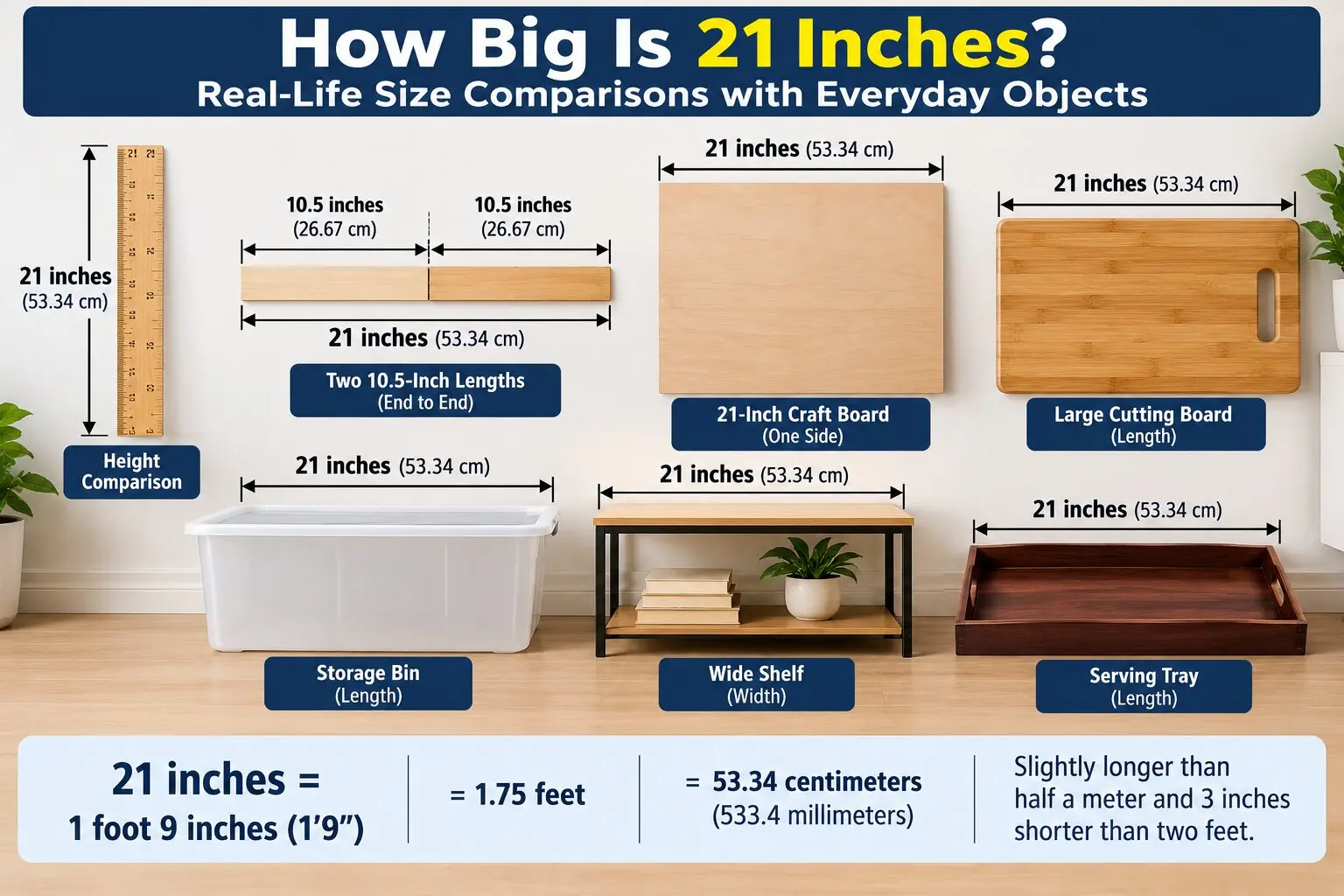
Twenty-one inches measure exactly 53.34 centimeters, making the distance 3.34 cm longer than half a meter.
Some useful visual comparisons include:
Two 10.5-inch lengths: Together, they measure exactly 21 inches.
21-inch craft board: One correctly measured side provides a direct reference.
Large cutting board: Certain models have a specified 21-inch length.
Storage bin: Some household containers measure approximately 21 inches along an exterior edge.
Wide shelf: A shelf with a verified 21-inch width provides a horizontal comparison.
Serving tray: Some larger trays have a stated 21-inch exterior length.
For perspective, 21 inches are one inch longer than 20 inches and three inches longer than 18 inches.
These comparisons are useful when the actual dimensions of an object are known. Ordinary household products vary in size, so they should not automatically be treated as precise measuring references.
1. Two 10.5-Inch Lengths
Two strips of paper or card, each cut to exactly 10.5 inches, create a combined length of 21 inches (53.34 cm) when placed end to end.
This provides a reproducible reference without relying on household objects with unknown dimensions.
Place the two strips along the same straight line, ensuring there is no gap or overlap between their ends.
Because each strip measures half the target length, their combined distance is exactly 21 inches when correctly measured.
2. A 21-Inch Square Craft Board
Craft boards, mounting boards, and decorative materials can be cut to 21 × 21-inch dimensions.
Each side measures 21 inches (53.34 cm) when accurately cut and measured.
A square board provides a straightforward reference for understanding this distance horizontally or vertically.
Its flat surface also makes it useful for comparing furniture parts, storage products, and household accessories.
Check the board’s finished dimensions before using it as a precise reference.
3. A Large Cutting Board
Large cutting boards come in different dimensions, including rectangular models with a specified 21-inch length.
A board measuring 53.34 cm along its longer edge provides a familiar kitchen comparison.
However, the stated dimensions may include handles, rounded edges, or other features that extend beyond the cutting surface.
Check whether the manufacturer measures the entire board or only the usable surface.
A cutting board with a verified 21-inch overall length provides a more dependable comparison than a generic large board.
4. A Storage Bin With a 21-Inch Side
Storage bins and household organizers are available in many sizes, including products with a specified 21-inch exterior length.
A container measuring 53.34 cm along one outside edge provides a practical rectangular reference.
However, the usable storage space is generally smaller than the exterior dimensions because of wall thickness, handles, and lids.
Check the manufacturer’s stated measurements before using a particular storage bin as a 21-inch reference.
5. A Wide Shelf
Some desk shelves and wall-mounted shelves have a specified exterior width of 21 inches.
A shelf measuring 53.34 cm from one outer side to the other provides a useful horizontal comparison.
This measurement may describe the total width rather than the usable space between supports.
Check the product’s stated dimensions before using it to estimate the size of another object.
6. A Large Serving Tray
Serving trays are manufactured in various sizes, including rectangular designs with a specified 21-inch exterior length.
A tray measuring 53.34 cm along one edge provides another practical household reference.
However, the interior serving surface may be smaller than the exterior length because of raised rims and handles.
For an accurate comparison, confirm whether the stated 21 inches describe the tray’s complete exterior or its usable interior.
How to Measure 21 Inches Without a Tape Measure
If you don’t have a tape measure nearby, you can estimate 21 inches using objects with known dimensions.
1. Use two 10.5-inch strips. Place them end to end without gaps or overlap to create a combined length of 21 inches.
2. Compare with a verified craft board. A board accurately cut to 21 inches along one side provides a direct reference.
3. Use a measured cutting board. Compare with a board whose exterior length is confirmed as 21 inches.
4. Compare with a known-size shelf or storage bin. Use an object with a verified 21-inch exterior dimension.
5. Use half a meter as a close reference. Fifty centimeters are 3.34 cm shorter than 21 inches, making half a meter useful for a rough comparison.
Avoid assuming that ordinary suitcases, backpacks, TV remotes, or forearms measure exactly 21 inches.
These comparisons are useful for visual estimates. Use an accurately marked measuring tool when precise dimensions are required.
How to Measure 21 Inches Using a 12-Inch Ruler
A standard school ruler measures 12 inches, so you need another nine inches to reach 21 inches.
Follow these steps:
Align the ruler’s zero mark with your starting point.
Mark where the ruler reaches 12 inches.
Reposition the ruler so its zero mark aligns with that mark.
Measure nine additional inches along the same straight line.
The final endpoint is exactly 21 inches from the starting position.
In other words, 12 inches plus nine additional inches equal 21 inches.
If you’re using a metric ruler, measure exactly 53.34 cm instead.