7 cm (seven centimeters) equals exactly 70 millimeters or approximately 2.76 inches. That’s almost 2¾ inches and slightly shorter than 3 inches.
To see what 7 cm actually looks like, find the distance between the 0 and 7 cm marks on a metric ruler. You can also picture a 70 mm wooden craft ball, three US quarters arranged edge to edge, or the shorter side of a US dollar bill with a little extra length added.
The examples below use verified official measurements, manufacturer-published specifications, and standard dimensions. Each comparison distinguishes objects with a stated 70 mm size from those that are slightly longer or shorter.
What Does 7 CM Look Like? Everyday Objects
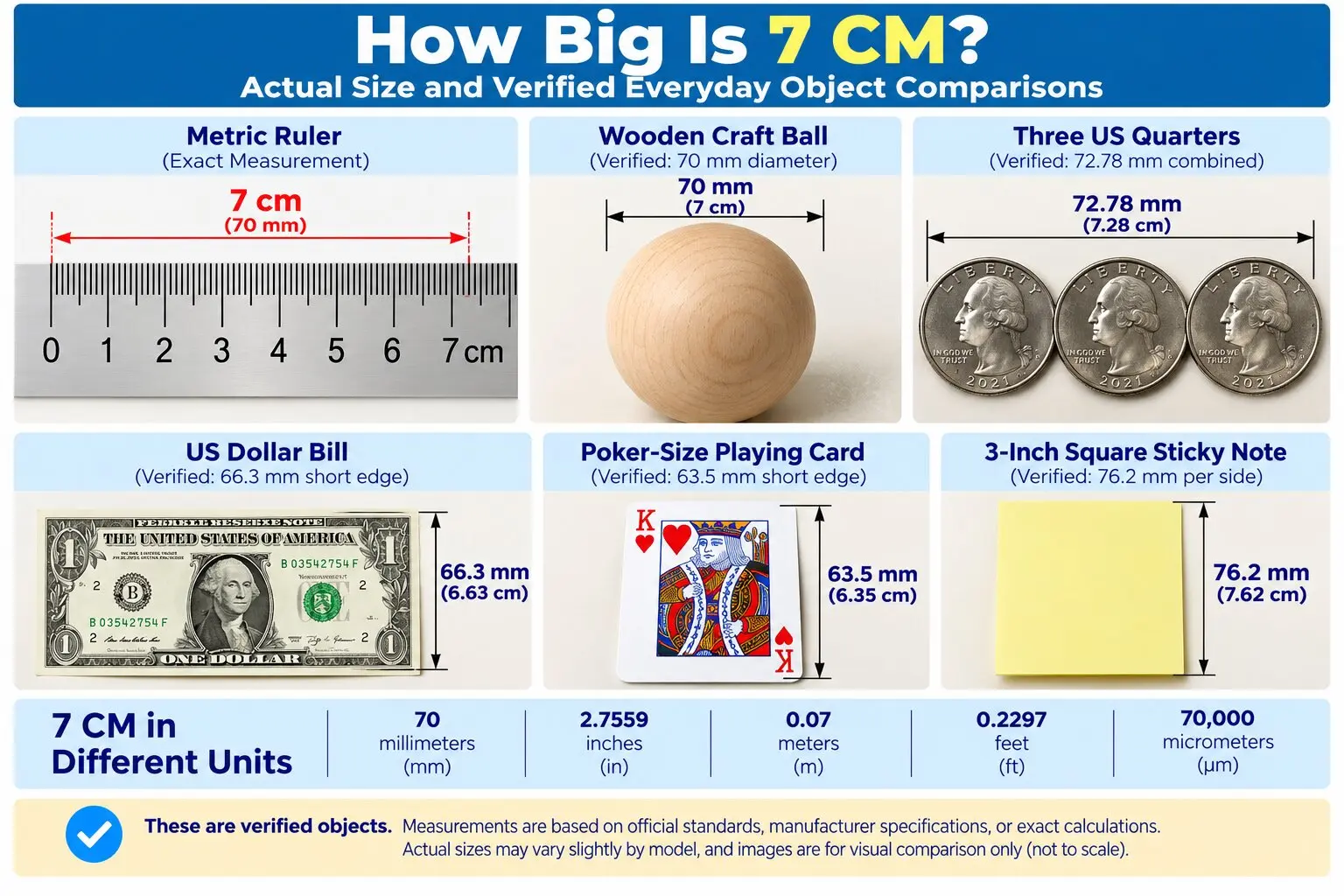
Seven centimeters is a little longer than the shorter side of a US dollar bill and slightly shorter than three US quarters placed in a straight row.
Here are five everyday objects and one measuring reference to help visualize its size.
| Object or Reference | Documented Measurement | Comparison |
|---|---|---|
| Metric ruler | 70 mm interval | Exact measurement |
| VBS wooden craft ball | Nominal 70 mm diameter | Manufacturer-specified |
| Three US quarters | 72.78 mm combined diameters | 2.78 mm longer |
| US dollar bill | Approximately 66.3 mm short edge | About 3.7 mm shorter |
| Poker-size playing card | 63.5 mm short edge | 6.5 mm shorter |
| 3-inch square sticky note | 76.2 mm per side | 6.2 mm longer |
These measurements are supported by official coin and currency specifications, documented product sizes, and established measurement standards.
The term verified refers to dimensions checked against published sources rather than independent physical testing of individual objects. Actual product dimensions may vary slightly.
1. The 7 CM Mark on a Metric Ruler
A metric ruler provides the most reliable way to see seven centimeters.
Find the zero mark and locate the 7 cm mark. The distance between them measures exactly 70 millimeters (7 cm) on an accurately marked ruler.
Each centimeter contains ten millimeters, so seven centimeters contain seventy millimeters.
You can measure this distance vertically or horizontally without changing its length.
Unlike visual comparisons with manufactured objects, an accurately marked ruler provides a direct measurement.
2. A 70 MM Wooden Craft Ball
Large wooden craft balls are available with a manufacturer-listed diameter of 70 mm (7 cm).
For example, VBS Hobby offers half-drilled beech-wood balls with a specified outside diameter of 70 mm and a separate 10 mm hole.
Imagine placing one beside a metric ruler. Measuring straight across its widest point provides a three-dimensional reference for seven centimeters.
The stated 70 mm dimension refers to the ball’s outside diameter, not the central hole.
A 50 mm wooden ball used to visualize 5 cm is 20 mm smaller in diameter. Comparing these two specified sizes makes the difference easier to picture.
The measurements refer to the manufacturer’s published dimensions, and individual products may vary within manufacturing tolerances.
3. Three US Quarters Side by Side
A US quarter has an official diameter of 24.26 mm, according to the United States Mint.
Place three quarters edge to edge in a straight line, without leaving gaps or overlapping them.
Their combined diameters equal:
24.26 mm × 3 = 72.78 mm
That’s approximately 7.28 cm, making the row just 2.78 mm longer than seven centimeters.
This is one of the most practical comparisons because quarters have an officially specified diameter.
The measurement refers to the combined diameters of three coins arranged side by side, not the height of a stack.
4. The Shorter Edge of a US Dollar Bill
A modern US dollar bill measures approximately 6.14 × 2.61 inches, according to the US Currency Education Program.
Its shorter edge measures approximately 66.3 mm (6.63 cm).
That’s around 3.7 mm shorter than seven centimeters.
Hold the bill horizontally and look at the distance between its top and bottom edges. This narrower dimension provides a familiar reference.
The shorter edge is also a useful comparison for a length of about 6 cm. At approximately 6.63 cm, it falls between six and seven centimeters.
The longer side of a dollar bill measures approximately 15.6 cm and should not be confused with this comparison.
5. The Width of a Poker-Size Playing Card
A standard poker-size playing card has nominal dimensions of 2½ × 3½ inches, equivalent to 63.5 × 88.9 mm.
Its shorter edge measures 63.5 mm (6.35 cm).
That’s 6.5 mm shorter than seven centimeters.
Hold a playing card upright and look at its width from left to right. Imagine adding another 6.5 mm to reach seven centimeters.
The card’s longer edge measures 88.9 mm, so it isn’t the dimension being compared.
This reference applies specifically to poker-size playing cards. Bridge-size and specialty cards may have different widths.
6. A 3-Inch Square Sticky Note
Square sticky notes are available in a 3 × 3-inch format.
Since one inch equals exactly 25.4 mm, each side of a 3-inch square measures:
3 × 25.4 = 76.2 mm (7.62 cm)
That’s 6.2 mm longer than seven centimeters.
Imagine a 7 cm line drawn along one edge of a 3-inch square sticky note. A small section would remain beyond the line.
This is a useful office and stationery comparison, although it is not an exact 7 cm object.
The measurement applies to notes specified as 3-inch squares rather than every sticky note.
How Long Is 7 CM in Inches and Millimeters?
7 cm equals exactly 70 millimeters and approximately 2.7559 inches.
Here are the conversions into other common measurement units:
| Unit | 7 CM Equals |
|---|---|
| Millimeters | 70 mm |
| Inches | Approximately 2.7559 in |
| Meters | 0.07 m |
| Feet | Approximately 0.2297 ft |
| Micrometers | 70,000 µm |
Seven centimeters is almost exactly 2¾ inches.
Two and three-quarter inches equal 69.85 mm, making seven centimeters just 0.15 mm longer.
For a larger reference, 8 cm measures exactly 80 mm, extending one additional centimeter beyond the 7 cm mark. Comparing these nearby distances on a metric ruler helps illustrate the difference.
Is 7 CM Almost 3 Inches?
Yes. Seven centimeters is approximately 2.76 inches, which is slightly shorter than three inches.
Three inches equal exactly 7.62 cm.
The difference is 0.62 cm, or 6.2 mm.
That means a standard 3-inch square sticky note provides a convenient visual reference, but its sides are slightly longer than seven centimeters.
You can explore familiar objects measuring about 3 inches to compare the two measurements in everyday situations.
For quick estimates, picturing seven centimeters as slightly under three inches is helpful. For exact measurements, use a ruler.
How to Measure 7 CM Accurately
The easiest way to measure seven centimeters is with a metric ruler.
Place the ruler beside the object on a flat surface.
Align the object’s starting edge with the zero mark.
Locate the 7 cm mark, equivalent to 70 mm.
Check whether the opposite edge reaches that position.
You can also divide seven centimeters into two equal sections of 3.5 cm each.
Measuring both sections along the same straight line gives a combined distance of exactly 7 cm.
Repeating a 7 cm measurement twice produces 14 cm (140 mm), which can be useful when measuring longer distances in equal sections.
For round objects such as wooden balls, measure straight across the widest part through the center to determine the diameter.
A caliper can provide greater precision when measuring small manufactured parts.
Can You Estimate 7 CM Without a Ruler?
Yes. Several familiar objects can help you estimate seven centimeters.
Three US quarters arranged edge to edge span approximately 7.28 cm, making them one of the closest practical comparisons.
The shorter edge of a US dollar bill is approximately 6.63 cm, while a poker-size playing card measures 6.35 cm across its narrower side.
A wooden craft ball with a specified 70 mm diameter provides another useful reference.
These comparisons help with visual estimation but should not replace a ruler or caliper when accuracy matters.
An image displayed on a phone or computer may also appear larger or smaller than its intended size because of screen scaling, resolution, and zoom settings.