5 cm (five centimeters) equals exactly 50 millimeters or approximately 1.97 inches. That’s just 0.8 mm shorter than 2 inches and almost the same length as a standard AA battery.
To see what 5 cm actually looks like, find the distance between the 0 and 5 cm marks on a metric ruler. You can also picture the shorter edge of a credit card, one side of a 2-inch square sticky note, or a 50 mm wooden craft ball.
The examples below use verified measurement standards, published manufacturer specifications, and exact conversions. Each comparison identifies which objects closely match 5 cm and which are slightly longer.
What Does 5 CM Look Like? Everyday Objects
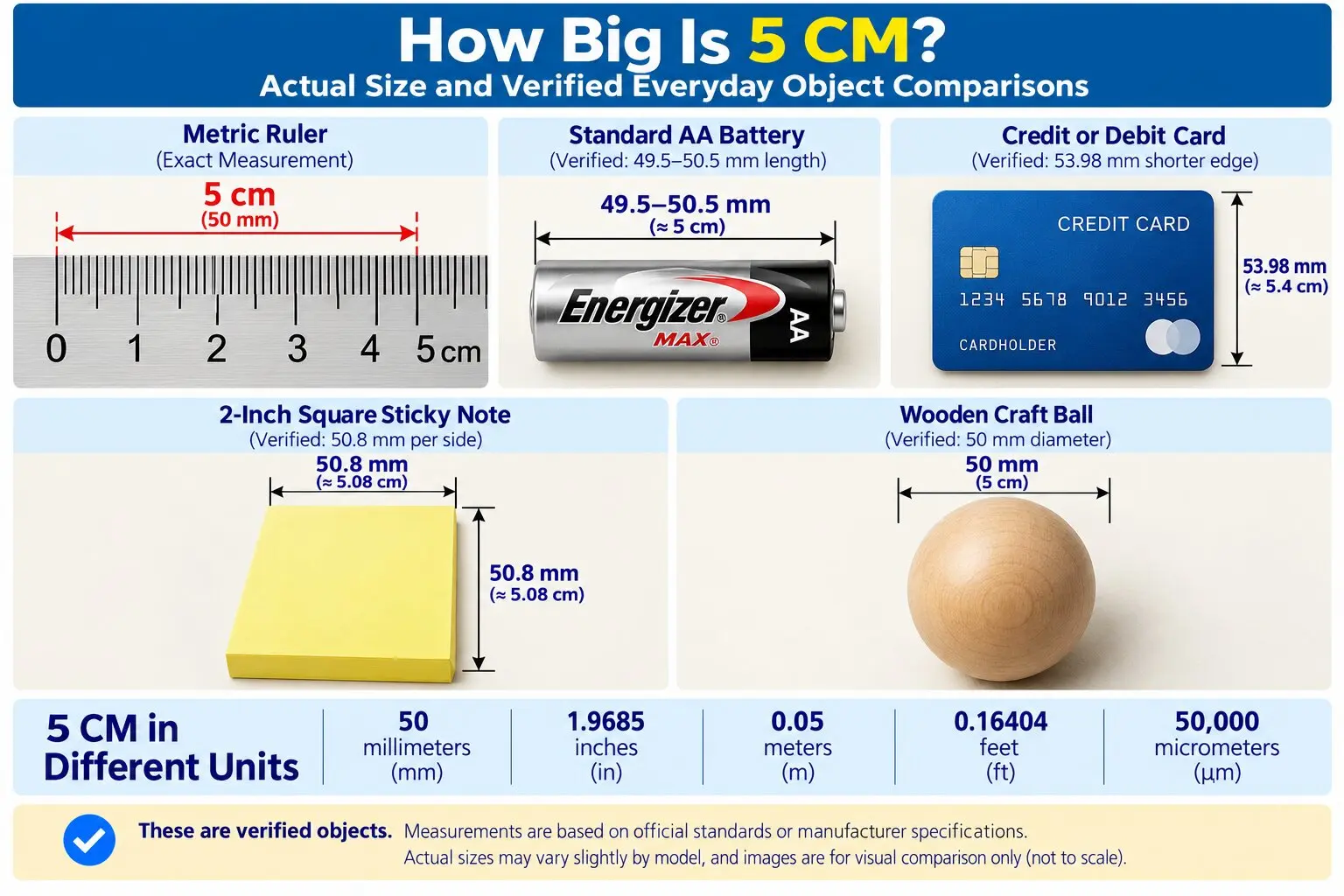
Five centimeters is almost two inches long. A standard AA battery provides one of the closest familiar comparisons, while the shorter edge of a credit card is slightly longer.
Here are five useful measuring references and everyday objects:
| Object or Reference | Documented Measurement | Comparison |
|---|---|---|
| Metric ruler | 50 mm interval | Exact measurement |
| Standard AA battery | 49.5–50.5 mm overall length | Very close |
| Standard credit or debit card | 53.98 mm shorter edge | 3.98 mm longer |
| 2-inch square sticky note | 50.8 mm per side | 0.8 mm longer |
| VBS wooden craft ball | 50 mm outer diameter | Manufacturer-specified |
These comparisons are based on published specifications, standardized dimensions, or exact calculations. They do not mean that every individual manufactured object has been independently measured or is identical in size.
1. The 5 CM Mark on a Metric Ruler
A metric ruler is the most reliable reference for five centimeters.
Find the zero mark and locate the 5 cm mark. The distance between them measures exactly 50 millimeters (5 cm) on an accurately marked ruler.
Each centimeter contains ten millimeter intervals, so five centimeters contain fifty.
This provides a direct measurement without depending on the size of a household object.
You can also compare a shorter distance on the same ruler. For example, a regulation table tennis ball measures 4 cm across, making its specified diameter exactly one centimeter smaller than a 50 mm wooden craft ball.
2. The Length of a Standard AA Battery
A standard AA battery is one of the closest everyday comparisons to five centimeters.
According to Energizer’s E91 AA battery specifications, the overall length ranges from 49.5 to 50.5 mm.
That’s equivalent to approximately 4.95–5.05 cm, making an AA battery almost exactly five centimeters long.
Imagine the battery standing upright on a flat surface. The measurement runs from its bottom contact to the top of its positive terminal.
Its diameter is much smaller, so the comparison refers to the battery’s complete length rather than its width.
3. The Shorter Edge of a Credit Card
A standard credit or debit card has nominal dimensions of 85.60 × 53.98 mm, following the ISO/IEC 7810 ID-1 card format.
Its shorter edge measures 53.98 mm (approximately 5.4 cm).
That’s only 3.98 mm longer than five centimeters.
Hold the card horizontally and look at the distance from its top edge to its bottom edge. That shorter dimension provides a convenient physical reference.
The card’s longer side measures 8.56 cm, so it should not be confused with the approximately 5 cm dimension.
4. A 2-Inch Square Sticky Note
Small square sticky notes are available in a 2 × 2-inch size.
Because one inch equals exactly 25.4 mm, each side of a 2-inch square measures 50.8 mm (5.08 cm).
That’s just 0.8 mm longer than five centimeters.
Picture a small square sticky note resting on a desk. Its width or height provides a close visual comparison.
The relationship is based on the specified 2-inch size. Other sticky notes may measure 3 × 3 inches or have different dimensions, so this example applies only to the 2-inch format.
5. A 50 MM Wooden Craft Ball
Wooden craft balls are manufactured in several diameters, including 50 mm (5 cm).
For example, VBS Hobby lists drilled beech-wood craft balls with a specified outside diameter of 50 mm and a threading hole measuring 8 mm.
The 50 mm measurement refers to the ball’s full outside diameter, not its central hole.
Imagine the ball resting beside a metric ruler. Measuring straight across its widest point provides a three-dimensional reference for five centimeters.
Unlike the shorter edge of a credit card, which is slightly longer than 5 cm, this wooden ball has a manufacturer-specified diameter matching the target measurement.
How Long Is 5 CM in Inches and Millimeters?
5 cm equals exactly 50 mm and approximately 1.9685 inches.
Here are the conversions into other common units:
| Unit | 5 CM Equals |
|---|---|
| Millimeters | 50 mm |
| Inches | Approximately 1.9685 in |
| Meters | 0.05 m |
| Feet | Approximately 0.16404 ft |
| Micrometers | 50,000 µm |
Since one inch equals exactly 2.54 cm, two inches equal 5.08 cm.
That makes five centimeters just 0.8 mm shorter than 2 inches. Although these measurements look nearly identical on a ruler, they aren’t interchangeable when an exact fit is required.
For a slightly longer reference, 6 cm adds another centimeter to this measurement. Doubling 5 cm produces 10 cm, or exactly 100 mm. These comparisons make it easier to understand larger metric measurements without converting every length into inches.
Is 5 CM the Same as 2 Inches?
Not exactly. Five centimeters is slightly shorter than two inches, although the difference is less than one millimeter.
5 cm = 50 mm
2 inches = 50.8 mm
Difference = 0.8 mm
For everyday visual estimates, treating five centimeters as approximately two inches is reasonable.
However, the difference may matter when selecting replacement parts, craft materials, hardware, or objects that require a precise fit.
A ruler with both metric and imperial markings makes the distinction easy to see.
How to Measure 5 CM Accurately
The easiest way to measure five centimeters is with a metric ruler.
Place the ruler beside the object on a flat surface.
Align the object’s starting edge with the zero mark.
Locate the 5 cm mark, equivalent to 50 mm.
Check whether the opposite edge reaches that position.
You can also divide five centimeters into two equal sections of 2.5 cm each.
If you’re working with smaller measurements, start with a 2 cm length, measure another 2 cm, and then add one more centimeter to reach 5 cm.
For round objects such as wooden craft balls, measure straight across the widest point to determine their diameter.
A caliper is useful when greater precision is needed, particularly for manufactured items with small tolerances.
Can You Estimate 5 CM Without a Ruler?
Yes. A standard AA battery provides one of the most practical references because its overall length is approximately five centimeters.
The shorter edge of a credit card or one side of a 2-inch square sticky note can also help you visualize the distance.
A wooden craft ball with a specified 50 mm diameter is another useful reference for understanding the measurement across a round object.
However, these comparisons should not replace a measuring tool when accuracy matters.
An image displayed on a phone or computer may also appear larger or smaller than five centimeters because screen scaling, resolution, and zoom settings affect its physical size.