
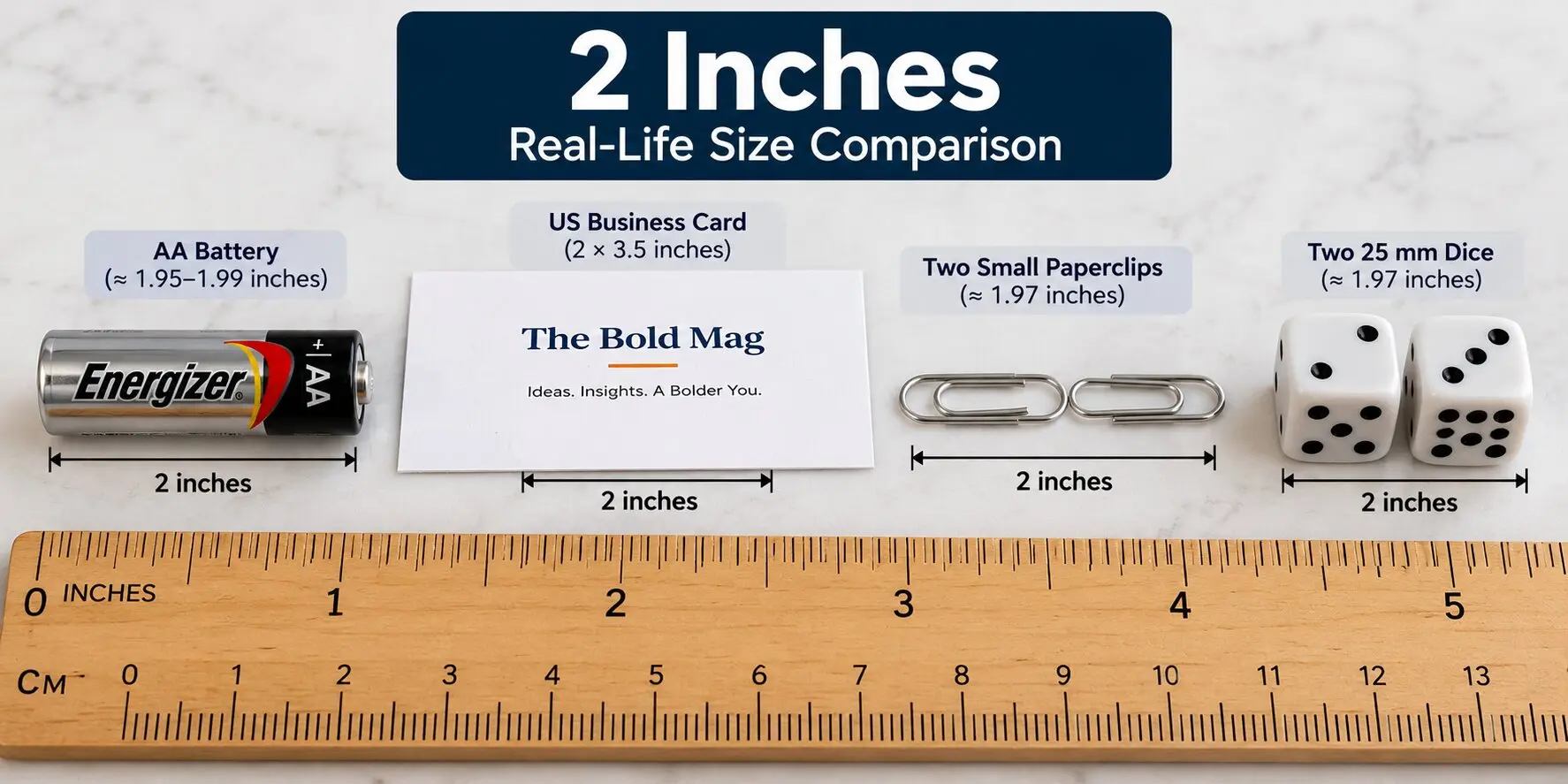
Two inches equal exactly 5.08 centimeters (cm) or 50.8 millimeters (mm). To picture this length, think of a standard AA battery, which measures almost 2 inches from end to end, or the short side of a US business card, which measures exactly 2 inches by its standard dimensions.
Understanding what 2 inches looks like can be useful when comparing small objects, choosing craft supplies, checking product dimensions, or estimating measurements without a ruler.
Below are 10 everyday objects that are exactly or approximately 2 inches long, along with their dimensions and practical ways to visualize this measurement.
What Does 2 Inches Look Like in Real Life?
Two inches is a relatively short length, equivalent to a little more than 5 centimeters. On a standard ruler, it is the distance from the zero mark to the number 2 on the inch scale.
Several familiar objects can help you visualize this size:
AA battery: Approximately 1.95–1.99 inches long.
US business card: Exactly 2 inches along its shorter side by standard dimensions.
Credit card: About 2.125 inches along its shorter edge, slightly longer than 2 inches.
Two 25 mm gaming dice: Approximately 1.97 inches when placed side by side.
These examples make it easier to estimate small distances, although not every household object has a fixed size.
For comparison, 1 inch is exactly half the length of 2 inches. Looking at objects of both sizes can help you recognize the difference more easily.
How Long Is 2 Inches in CM, MM, and Feet?
Two inches equal exactly 5.08 centimeters or 50.8 millimeters. Since one inch is defined as 25.4 mm, converting inches into metric measurements is straightforward.
| Unit | Equivalent |
|---|---|
| Centimeters | 5.08 cm |
| Millimeters | 50.8 mm |
| Meters | 0.0508 m |
| Feet | 1/6 foot |
| Yards | 1/18 yard |
These conversions are exact and apply regardless of the object being measured.
For everyday comparisons, 2 inches are twice as long as 1 inch and approximately 1.33 times the length of 1.5 inches.
10 Things That Are About 2 Inches Long
Here are 10 familiar objects that can help you understand the size of 2 inches. Some have established dimensions, while others must be selected in a specific size.
1. AA Battery
A standard AA battery is one of the closest everyday references for 2 inches. Its overall length is approximately 49.5–50.5 mm (1.95–1.99 inches), depending on the model and manufacturing specifications.
This makes an AA battery only slightly shorter than the exact 50.8 mm measurement.
AA batteries are commonly found in remote controls, toys, clocks, and flashlights. When you need to estimate the length of a small object, place an AA battery beside it and compare their ends.
Because AA batteries follow established dimensional specifications, they provide a more consistent reference than many household items.
2. US Business Card (Short Side)
A standard US business card measures 3.5 inches long and 2 inches wide (88.9 × 50.8 mm).
Its shorter edge is therefore an exact two-inch reference based on the standard finished-card dimensions.
Business cards are useful for comparing small flat objects, craft materials, packaging, or stationery. Place the shorter side beside the object you want to estimate.
Keep in mind that business-card dimensions vary internationally, so this comparison specifically applies to the standard US format.
3. Small Screwdriver Handle
Some precision screwdrivers have handles approximately 2 inches long, although their dimensions vary by model.
These compact tools are commonly used for repairing watches, eyeglasses, electronics, and other small devices.
If you own a precision screwdriver with a handle measuring around 50 mm, it can serve as a convenient visual reference for 2 inches.
Measure only the handle, not the metal shaft or the entire screwdriver. For an accurate comparison, check the tool’s dimensions first.
4. Credit Card (Short Edge)
The shorter edge of a standard credit or debit card measures 53.98 mm, equivalent to 2.125 inches.
That makes it approximately 3.18 mm longer than 2 inches.
Although it is not an exact match, a credit card is a convenient visual reference because its dimensions follow an established international card-size standard.
Place the card’s shorter edge beside a small object to estimate its length, keeping in mind that the card extends slightly beyond two inches.
5. Two Small Paperclips End to End
Two small paperclips measuring approximately 25 mm each can create a combined length close to 2 inches when placed end to end.
Together, they measure about 50 mm (1.97 inches), only 0.8 mm shorter than 2 inches.
Paperclips are available in different sizes, so this method works best when you know the dimensions of the clips you’re using.
For a slightly smaller size comparison, some larger paperclips approach 1.5 inches individually. You can explore other familiar examples in our guide to things that are 1.5 inches long.
6. Small Matchbox
A small matchbox may measure approximately 2 inches along one side, depending on its design and manufacturer.
Matchboxes come in different shapes and sizes, so they are less reliable than AA batteries or objects with standardized dimensions.
If your matchbox measures around 50–51 mm along its longer side, you can use it to visualize a two-inch distance.
This comparison can be helpful when estimating the dimensions of small packages or rectangular items around the home.
7. Two-Inch Sticky Note
Sticky notes are available in several sizes, including 2 × 2-inch square versions.
Each side of a nominal 2-inch square sticky note measures 50.8 mm, making it a simple reference for visualizing two inches on a flat surface.
You can place one beside small labels, cards, or craft materials to compare their dimensions.
However, the commonly used larger sticky notes are often 3 × 3 inches, so check the size on the packaging rather than assuming every sticky note measures two inches.
8. Small House Key
Some compact house keys measure approximately 2 inches from the tip of the blade to the opposite end of the head.
Because key designs vary, this is only an approximate example rather than a standard measurement.
A key with a verified length of about 50 mm can be useful for comparing small hardware, screws, or accessories.
For a more dependable estimate, measure your own key once and use it as a familiar personal reference.
9. Two 25 mm Gaming Dice
Two gaming dice measuring 25 mm along each edge provide a combined length of approximately 50 mm when placed side by side.
That equals about 1.97 inches, making the pair only 0.8 mm shorter than two inches.
Unlike smaller board-game dice, these larger 25 mm dice offer a closer match to the target measurement.
Place the dice next to each other without a gap and compare their combined width with the object you’re estimating.
10. Two-Inch Votive Candle
Some votive candles are sold with a nominal height of 2 inches (50.8 mm).
These small candles can help you visualize a short vertical measurement, particularly when comparing decorative accessories, containers, or candleholders.
However, candle dimensions vary between manufacturers, and not all votive candles measure two inches tall.
Choose a candle with a specified two-inch height if you want to use it as a reference.
How to Measure 2 Inches Without a Ruler
You don’t always have a ruler or measuring tape nearby. Fortunately, several familiar objects can help you estimate a two-inch distance.
1. Use an AA battery. Place the battery beside the object you’re measuring. Its length is close to 2 inches, making it a convenient reference.
2. Compare with a US business card. The shorter edge of a standard US business card is 2 inches long.
3. Line up two small paperclips. If each clip is approximately 25 mm, their combined length will be about 50 mm, close to 2 inches.
4. Place two US quarters side by side. The diameter of one quarter is 24.26 mm. Two quarters placed flat, edge to edge, span approximately 48.52 mm (1.91 inches), which is slightly shorter than 2 inches.
5. Use a familiar finger measurement. You can compare a finger segment against a ruler once and remember its actual length for future estimates. Finger dimensions vary, so this method works best as a personal reference.
These techniques help with rough comparisons, but they should not replace an actual ruler when precision matters.
If you’re working with a slightly longer object, remember that 2.5 inches equals 6.35 cm, which is half an inch longer than 2 inches.
How to Find 2 Inches on a Ruler
On an imperial ruler, 2 inches is the distance from the zero mark to the number 2.
Most inch rulers include smaller markings for fractions such as 1/4, 1/2, and 1/8 inch.
To measure two inches:
Place the object’s starting edge at the zero mark.
Align the object with the ruler.
Find the number 2 on the inch scale.
Check whether the object’s other end reaches that point.
If you’re using a metric ruler, locate 5 cm and move another 0.8 mm to reach exactly 5.08 cm.
Always measure from the zero mark rather than the physical edge of the ruler, which may have an additional margin.
How Much Bigger Are 3 and 4 Inches Than 2 Inches?
Comparing nearby measurements makes it easier to understand their relative sizes.
Three inches equal 7.62 cm, making that length 50% greater than 2 inches. For familiar comparisons, see our guide to things that are 3 inches long.
Four inches equal 10.16 cm, which is exactly twice the length of 2 inches. Our article about objects that are 4 inches long provides examples of this larger measurement.
These comparisons can be useful when choosing craft supplies, checking small product dimensions, or estimating the space an object will occupy.