
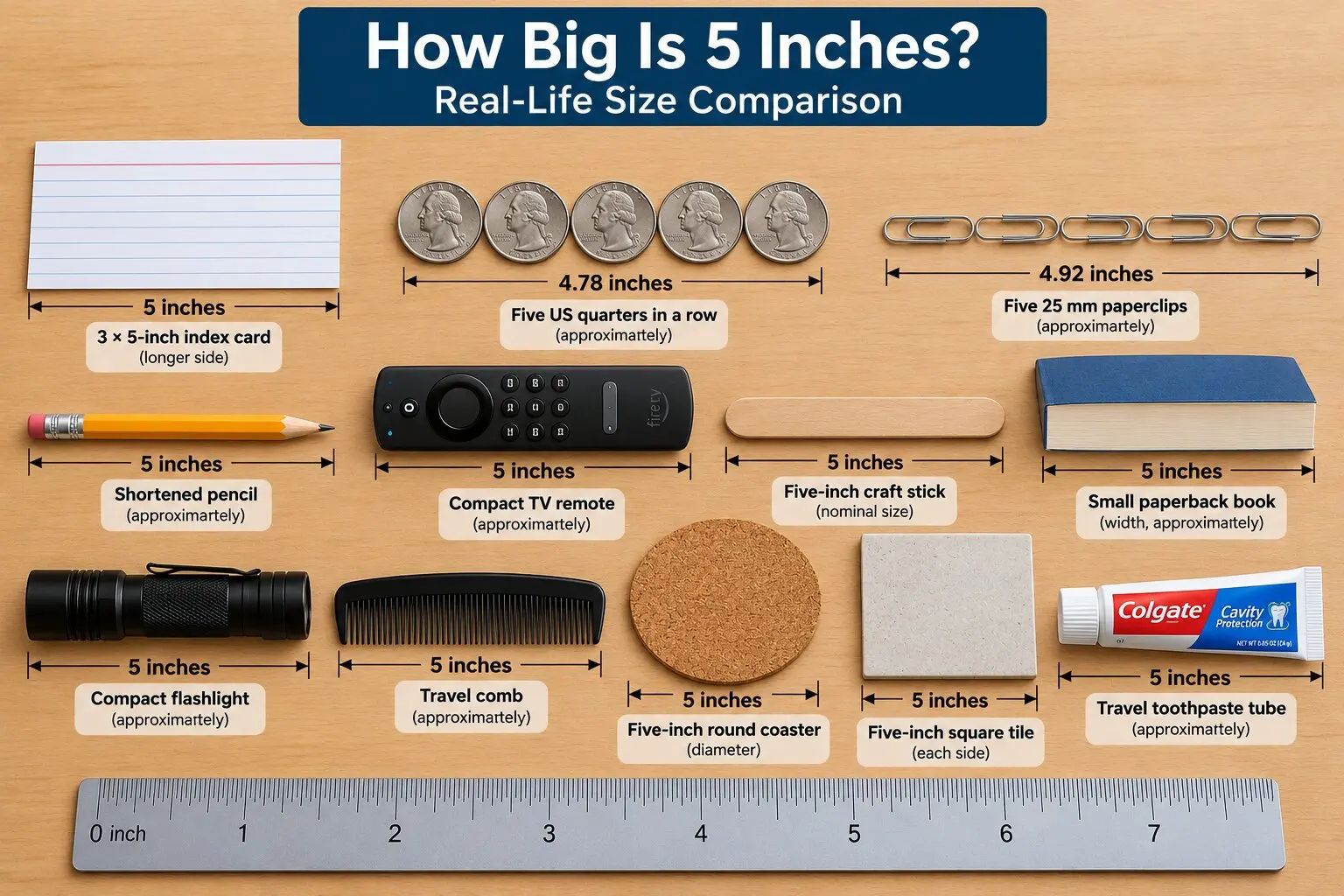
5 inches equal exactly 12.7 centimeters (cm) or 127 millimeters (mm). To picture this length, think of the longer side of a standard 3 × 5-inch index card or five US quarters placed in a row, which measure approximately 4.78 inches together.
Knowing what 5 inches looks like can be useful when comparing household objects, checking product dimensions, choosing craft supplies, or estimating small measurements without a ruler.
Below are 12 everyday objects and size comparisons that help you visualize 5 inches, including their actual or approximate dimensions.
What Does 5 Inches Look Like in Real Life?
Five inches are slightly shorter than 13 centimeters. On a standard inch ruler, the measurement extends from the zero mark to the number 5.
Some familiar visual references include:
3 × 5-inch index card: Its longer side measures 5 inches by its stated size.
Five US quarters: Approximately 4.78 inches when placed flat, edge to edge.
Five 25 mm paperclips: Approximately 4.92 inches when aligned end to end.
Five-inch craft stick: A craft stick specifically sold in this length provides another useful reference.
Compact TV remote: Some models measure approximately 5 inches long, although dimensions vary.
These objects can help you estimate five inches, but those with specified dimensions are more dependable than products that vary by manufacturer.
For perspective, five inches are one inch longer than 4 inches. Comparing objects of both sizes can make the difference easier to recognize.
How Long Is 5 Inches in CM, MM, and Feet?
Five inches equal exactly 12.7 centimeters or 127 millimeters. Since one inch is defined as 25.4 mm, multiplying by five gives the exact metric measurement.
| Unit | Equivalent |
|---|---|
| Centimeters | 12.7 cm |
| Millimeters | 127 mm |
| Meters | 0.127 m |
| Feet | 5/12 foot (approximately 0.4167 ft) |
| Yards | 5/36 yard (approximately 0.1389 yd) |
| Half of 5 inches | 2.5 inches (6.35 cm) |
These conversions are exact, apart from the rounded decimal values shown for feet and yards.
Five inches are also twice as long as 2.5 inches. For a smaller comparison, explore our guide to things that are 2.5 inches long.
12 Everyday Objects That Are About 5 Inches Long
The following examples include objects with stated dimensions and household items that may measure approximately five inches.
Because everyday products come in different sizes, each description explains which dimension to compare and whether the measurement is exact or approximate.
1. Standard 3 × 5-Inch Index Card
A standard 3 × 5-inch index card measures 5 inches (127 mm) along its longer edge and 3 inches (76.2 mm) along its shorter edge.
This makes it one of the easiest references for visualizing five inches. Its rectangular shape also helps when comparing flat objects such as small notebooks, labels, envelopes, or craft materials.
Place the longer side of the card beside the object you want to estimate and align one end.
Index cards are available in different sizes, so make sure yours is the 3 × 5-inch version before using it as a measuring reference.
2. Five US Quarters in a Row
A US quarter measures 24.26 mm in diameter. When five quarters are placed flat in a straight row with their edges touching, their combined length is approximately 121.3 mm (4.78 inches).
That’s 5.7 mm shorter than exactly five inches.
Although five quarters do not make an exact five-inch measurement, they offer a convenient visual comparison because their individual diameters are standardized.
Arrange the coins flat and edge to edge without gaps or overlaps. Stacking them vertically would measure their thickness rather than their combined diameters.
3. Shortened Pencil
A wooden pencil that has been used and sharpened repeatedly may eventually measure around 5 inches (in) from its tip to the opposite end.
Unlike a new pencil, which is generally longer, a shortened pencil can provide a familiar reference for small stationery items.
Pencil lengths vary depending on how much has been sharpened away, so this example works best when you have measured your particular pencil.
A pencil confirmed to be approximately 12.7 cm long can be useful for estimating the length of small tools, craft materials, or other narrow objects.
4. Compact TV Remote
Some compact television and streaming-device remotes measure approximately five inches from end to end.
Their slim rectangular shape makes them a convenient reference when comparing small electronic accessories or checking available storage space.
However, remote controls differ considerably between manufacturers and models. A larger TV remote may be much longer, while some compact versions are closer to four or four-and-a-half inches.
For a slightly smaller comparison, explore our guide to things that are 4.5 inches long.
If you want to use your own remote as a reference, measure its full length once rather than assuming it is exactly 5 inches.
5. Five-Inch Craft Stick
Craft sticks are available in several lengths, including versions sold in approximately five-inch sizes.
A craft stick with a verified length of 5 inches (127 mm) provides a useful straight reference for small measurements.
These flat wooden sticks are commonly used for school projects, homemade decorations, model making, and craft activities.
Place the stick beside the object you’re comparing and align the ends to estimate the length.
Check the packaging or measure the stick first because ordinary popsicle sticks and jumbo craft sticks do not all have the same dimensions.
6. Small Paperback Book
Some compact paperback books measure approximately 5 inches across the front cover.
This width refers to the distance from the spine to the outer edge of the cover, not the book’s height or thickness.
A paperback with a confirmed 5-inch width can help you visualize small rectangular objects, particularly stationery, packaging, and travel accessories.
However, paperback formats vary between publishers and editions. Measure the particular book before using its width as a dependable reference.
7. Compact Flashlight
Some compact flashlights measure approximately 5 inches from the front lens to the rear cap.
These handheld lights are commonly kept in cars, camping bags, toolboxes, and emergency kits.
A flashlight of this size provides a useful reference for visualizing a short cylindrical object.
Because flashlight dimensions depend on the model, check its specified overall length rather than assuming all compact flashlights measure five inches.
Some larger models are closer to 6 inches long, making them useful for comparing the next whole-inch measurement.
8. Travel Comb
A small travel comb may measure approximately 5 inches from one end to the other.
Compact combs are often designed to fit inside handbags, toiletry kits, or grooming pouches, making them familiar examples of narrow handheld objects.
A travel comb measuring around 12.7 cm can help you estimate the length of stationery, accessories, or small household tools.
However, comb lengths vary considerably. Use one with a verified five-inch length if you need a dependable reference.
9. Five Small Paperclips End to End
Five paperclips measuring approximately 25 mm each provide a combined length of 125 mm when placed in a straight line.
That equals approximately 4.92 inches, only 2 mm shorter than exactly five inches.
This makes them a useful near-five-inch reference when working with stationery or small craft materials.
To make the comparison, arrange the clips end to end without gaps or overlapping their ends.
Paperclips come in different sizes, so the estimate applies only when each clip measures approximately 25 mm.
10. Five-Inch Round Coaster
Round drink coasters are available in different diameters, including versions sold in nominal five-inch sizes.
A coaster measuring 5 inches across its center has a diameter of 127 mm.
This provides a visual reference for circular objects such as small plates, decorations, containers, and tabletop accessories.
For an accurate comparison, measure across the widest point of the coaster.
Because coaster sizes vary, check that yours is actually labeled or measured at five inches before relying on it.
11. Five-Inch Square Craft Tile
Some square craft and decorative tiles are available in nominal five-inch sizes.
A tile labeled 5 × 5 inches provides a reference for both length and width, with each side nominally measuring 127 mm.
This makes it useful for visualizing small square surfaces, craft layouts, decorative pieces, or tabletop objects.
However, tile dimensions can differ from their nominal sizes due to manufacturing specifications.
Check the actual dimensions of the tile you are using, particularly when planning installations or projects that require precise spacing.
12. Small Travel Toothpaste Tube
Some travel-size toothpaste tubes may measure approximately five inches from the sealed end to the cap.
Their compact shape makes them familiar references when organizing toiletries or checking whether small items will fit inside travel pouches.
However, toothpaste tubes are produced in many sizes, and their length changes depending on the packaging design and whether the tube is folded or squeezed.
A travel tube with a verified overall length close to 12.7 cm can serve as a convenient visual reference, but it should not be considered a standardized five-inch object.
How to Measure 5 Inches Without a Ruler
If you don’t have a ruler or measuring tape nearby, you can estimate five inches using objects with known dimensions.
1. Use a 3 × 5-inch index card. Its longer edge measures five inches by its stated size, making it one of the simplest references.
2. Place five US quarters edge to edge. Their combined diameters measure approximately 121.3 mm (4.78 inches), slightly shorter than five inches.
3. Line up five small paperclips. If each measures 25 mm, their combined length is approximately 125 mm (4.92 inches).
4. Use a verified five-inch object. A measured craft stick, tile, coaster, or other product with a known dimension can serve as another reference.
5. Calibrate a personal reference. Measure a convenient part of your hand against a ruler once, then use that known distance for future rough estimates.
These methods can help with everyday comparisons, but they should not replace accurate measuring tools when cutting materials or checking whether objects will fit together.
How to Find 5 Inches on a Ruler
On an imperial ruler, five inches is the distance between the zero mark and the number 5.
To measure this length:
Place the starting edge of the object at the ruler’s zero mark.
Align the object alongside the measurement markings.
Find the number 5 on the inch scale.
Check whether the object’s opposite end reaches that mark.
On a metric ruler, five inches equal exactly 12.7 cm. Locate the 12 cm mark and move another 7 mm to reach the full measurement.
For better accuracy, read the scale directly from above and make sure the object remains straight.