2 cm (two centimeters) equals exactly 20 millimeters or approximately 0.79 inches. That’s slightly smaller than one inch and close to the diameter of a US penny or nickel.
To picture its actual size, look at the distance between the 0 and 2 cm marks on a metric ruler. You can also compare it with a 20 mm round craft bead, a small cabinet knob, or the width of a 20 mm watch strap.
The examples below use official measurement standards and published manufacturer specifications, with clear distinctions between exact, nominal, and approximate dimensions.
What Does 2 CM Look Like? Everyday Examples
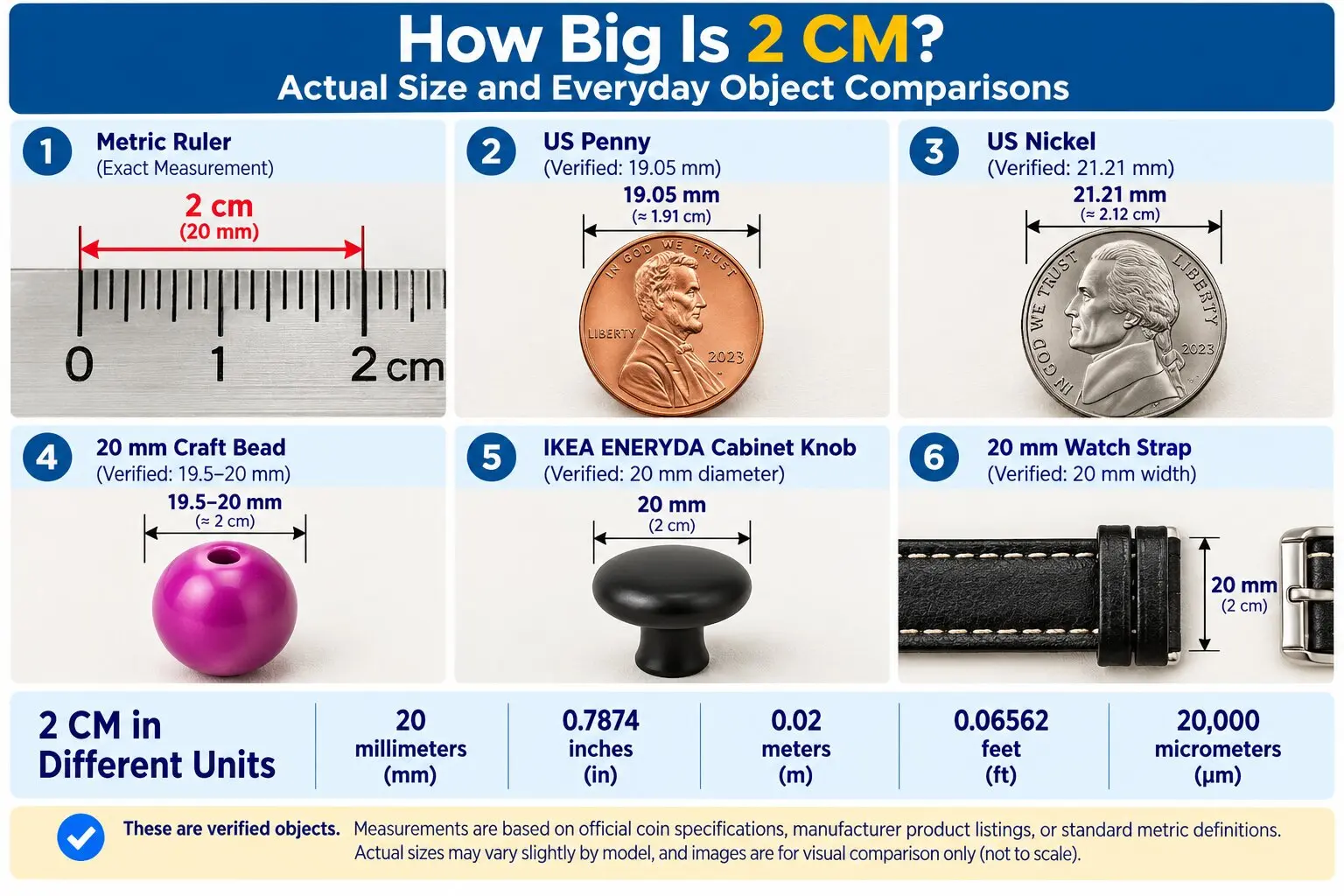
Two centimeters is a distance of exactly 20 millimeters, slightly larger than a US penny and slightly smaller than a US nickel.
On a metric ruler, the distance from 0 to 2 cm contains 20 millimeter intervals.
For another visual comparison, imagine a small round object measuring 20 mm across. That is the diameter of a specified 20 mm button, craft bead, or cabinet knob.
Here are six useful references based on documented dimensions:
| Object or Reference | Documented Measurement | Comparison |
|---|---|---|
| Metric ruler | 20 mm interval | Exact |
| US penny | 19.05 mm diameter | 0.95 mm smaller |
| US nickel | 21.21 mm diameter | 1.21 mm larger |
| BeadTin craft bead | 19.5–20 mm diameter | Very close |
| IKEA ENERYDA cabinet knob | 20 mm diameter | Manufacturer-specified |
| Seiko 20 mm watch strap | 20 mm stated width | Manufacturer-specified size |
These measurements come from official coin specifications, product documentation, or the metric system. They describe published dimensions rather than objects independently measured for this article.
1. The 2 CM Mark on a Metric Ruler
The most reliable way to see two centimeters is to use a metric ruler.
Find the zero mark and look at the distance to the 2 cm mark. That complete distance represents 20 millimeters (2 cm).
The 1 cm mark sits exactly halfway between the two endpoints.
This is a dependable reference because it shows the measurement directly.
If you’re familiar with how big 1 cm is, simply picture two consecutive centimeter intervals.
2. The Diameter of a US Penny
A US one-cent coin has an officially specified diameter of 19.05 mm (1.905 cm).
According to the United States Mint, this is the standard diameter of a penny.
That’s only 0.95 mm smaller than 2 cm, making it one of the closest familiar coin comparisons.
Place a penny flat on a table and imagine measuring across its circular face from one edge to the opposite edge.
The measurement refers to its diameter, not its thickness.
3. The Diameter of a US Nickel
A US five-cent nickel measures 21.21 mm (2.121 cm) in diameter, according to the United States Mint.
That’s 1.21 mm larger than 2 cm.
A nickel therefore provides a useful comparison for an object slightly wider than two centimeters.
If you place a penny and nickel beside each other, a 2 cm diameter falls between their sizes.
Both coins have officially documented dimensions, making them dependable physical references.
4. A 20 MM Round Craft Bead
Large round craft beads are manufactured in different diameters, including nominal 20 mm sizes.
For example, BeadTin specifies its white opaque round plastic beads as measuring 19.5–20 mm across.
The measurement refers to the bead’s outer diameter, while its threading hole is much smaller.
A bead of this size provides a close physical comparison with two centimeters.
Because its published diameter is a small range rather than one fixed value, the bead should be treated as a near match, not a guaranteed exact 20 mm object.
5. An IKEA ENERYDA Cabinet Knob
A small cabinet knob is another familiar example of an object measuring two centimeters across.
IKEA lists its ENERYDA 20 mm cabinet knob with a diameter of exactly 20 mm (2 cm) in the published product specifications.
The same listing gives its length as 21 mm.
When viewed from the front, the knob’s circular face provides a useful reference for a 2 cm diameter. Its depth is a separate measurement and is slightly greater.
The specified 20 mm diameter applies to this particular size, not every cabinet knob.
6. The Width of a 20 MM Watch Strap
Watch straps are manufactured in different widths, including 20 mm.
Seiko has documented nylon watch straps available in 18 mm, 20 mm, and 22 mm widths.
A strap specified as 20 mm wide measures 2 cm across that stated dimension.
The width is commonly considered at the section where the strap connects to the watch case.
Remember that the entire watch strap is much longer than two centimeters. Only its specified width represents the comparison.
How Much Is 2 CM in Inches and Millimeters?
2 cm equals exactly 20 millimeters and approximately 0.7874 inches.
Here are the conversions into other common units:
| Unit | 2 CM Equals |
|---|---|
| Millimeters | 20 mm |
| Inches | Approximately 0.7874 in |
| Meters | 0.02 m |
| Feet | Approximately 0.06562 ft |
| Micrometers | 20,000 µm |
One inch equals exactly 2.54 centimeters, making two centimeters 5.4 millimeters shorter than one inch.
Two centimeters is also exactly twice the length of one centimeter.
To understand how big 2 cm is compared with nearby measurements, 1 cm is half as long, while 3 centimeters is one centimeter longer. 4 cm is exactly twice the length of 2 cm, and 5 cm is two and a half times as long. Comparing these distances side by side on a metric ruler makes their differences easier to visualize.
How Wide Is 2 CM?
2 cm is exactly 20 mm wide, equivalent to approximately 0.79 inches.
The measurement remains the same whether it describes length, width, or height. Only the direction changes.
For a visual width comparison, picture the diameter of IKEA’s 20 mm cabinet knob or the stated width of a 20 mm watch strap.
A US penny is slightly narrower than 2 cm, while a nickel is slightly wider.
When measuring an object, distinguish its width from its length, depth, or thickness.
How to Measure 2 CM Accurately
A metric ruler is the simplest tool for measuring two centimeters.
Place the ruler beside the object on a flat surface.
Align one edge of the object with the zero mark.
Locate the 2 cm mark, equivalent to 20 mm.
Check whether the opposite edge reaches that position.
For circular objects, measure straight across the center to determine the diameter.
A caliper can provide greater precision when measuring coins, buttons, beads, and small hardware components.
Can You Estimate 2 CM Without a Ruler?
Yes. You can estimate two centimeters using objects with documented dimensions.
A US penny measures 19.05 mm across, while a nickel measures 21.21 mm. Both are close to the 20 mm target.
A nominal 20 mm craft bead or a cabinet knob with a specified 20 mm diameter can also help you visualize the length.
However, these comparisons should not replace accurate measuring tools when small differences matter.
An image displayed on a phone or computer may not show two centimeters at its actual physical size because screen scaling and zoom settings can change its appearance.