
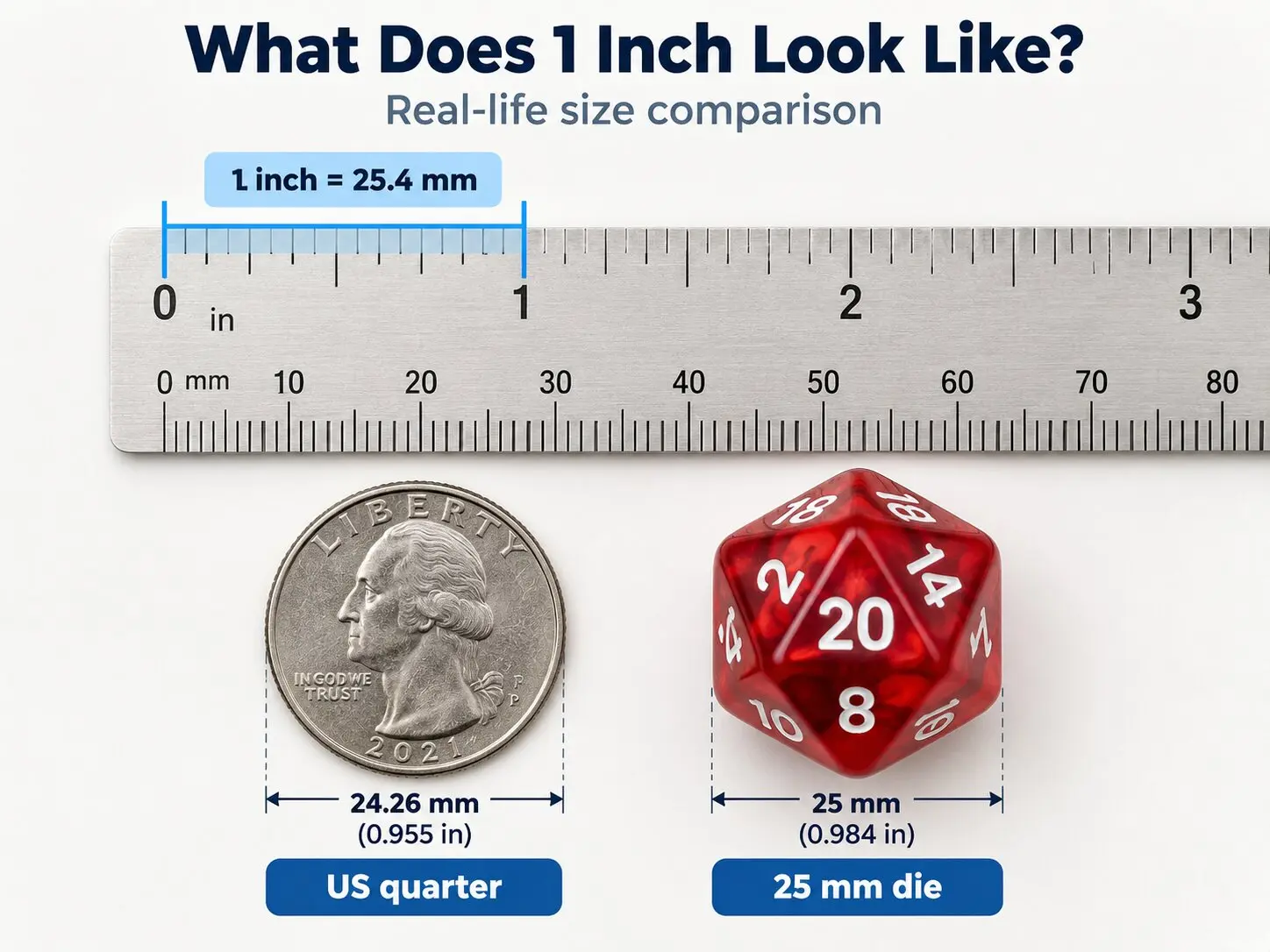
One inch is exactly 2.54 centimeters (cm) or 25.4 millimeters (mm). To picture how long 1 inch is, imagine the diameter of a US quarter, which is slightly smaller than an inch, or a 25 mm gaming die, which is almost the same size.
An inch may look small, but understanding its length can be useful when checking product dimensions, choosing craft supplies, or estimating the size of everyday objects.
Below, you’ll find familiar objects close to one inch, their actual or approximate dimensions, and ways to estimate the measurement without a ruler.
How Big Is 1 Inch in Real Life?
One inch is exactly 2.54 centimeters or 25.4 millimeters. If you’re wondering what 1 inch looks like, imagine the diameter of a US quarter, which measures 24.26 mm and is slightly smaller than an inch. A 25 mm gaming die is another close comparison. These familiar objects can help you estimate the size of one inch without a ruler, although exact measurements require a proper measuring tool.
How long is 1 Inch in Other Units?
The international inch has been defined as exactly 25.4 millimeters since 1959. Its metric equivalent is therefore 2.54 centimeters.
| Measurement | Equivalent |
|---|---|
| 1 inch in centimeters | 2.54 cm |
| 1 inch in millimeters | 25.4 mm |
| 1 inch in meters | 0.0254 m |
| 1 inch in feet | 1/12 foot |
| 1 inch in yards | 1/36 yard |
| Half an inch | 1.27 cm |
| Quarter of an inch | 0.635 cm |
These are exact unit conversions, not estimates.
Related: Things that are 3 inches long
10 Everyday Things That Are About 1 Inch Long
Not every everyday object has a fixed size. Some examples below have published dimensions, while others are available in different sizes. Knowing the difference makes them more useful as visual references.
1. US Quarter — 0.955 Inches
A US quarter is one of the easiest objects to compare with an inch. Its official diameter is 24.26 mm, equivalent to approximately 0.955 inches.
That makes the coin just 1.14 mm smaller than one inch.
Place a quarter flat beside a small object and compare their widths. It works well for a rough visual estimate, particularly when checking small decorations, buttons, or craft materials.
The coin’s diameter is a standardized specification, so it is more dependable than an object whose size changes between manufacturers.
2. US Dollar Coin — 1.043 Inches
A US Native American dollar coin measures 26.49 mm across, or about 1.043 inches.
It is approximately 1.09 mm wider than an inch.
This gives you a useful comparison on the opposite side of the measurement: a quarter is slightly smaller than an inch, while this dollar coin is slightly larger.
If you have both coins, the exact length of one inch falls between their diameters.
3. Width of an Adult Thumb
The width of an adult thumb near the nail can be close to an inch, although this varies considerably between people.
To use your thumb as a measuring reference, first compare its width against the 2.54 cm mark on a ruler. Once you know your own thumb measurement, you can use it for quick estimates.
This can be convenient when comparing small objects, but it is not a dependable substitute for a ruler when cutting or fitting materials.
4. Small Paperclip
Small paperclips can provide a convenient size comparison if you choose one that measures approximately 25 mm from end to end.
Because paperclips come in different lengths, not every small paperclip measures one inch. Check the length of the clip you have before using it as a reference.
A verified 25 mm paperclip is just 0.4 mm shorter than one inch, making it useful for estimating short straight lengths on a desk.
5. Plastic Bottle Cap
The diameter of a plastic water-bottle cap may be close to an inch, depending on the bottle and closure design.
Caps vary in diameter between brands and packaging types, so they should not be treated as standardized one-inch objects.
If you have a cap that measures approximately 25–26 mm across, you can use it as a convenient visual comparison for small round objects.
Measure across the widest part of the cap rather than its height.
6. 25 mm Gaming Die
A large gaming die measuring 25 mm along each edge is almost exactly one inch wide.
The difference is only 0.4 mm, making this specific die size a useful reference for length, width, and height.
However, ordinary board-game dice are often smaller. Check the stated size rather than assuming every die measures one inch.
A 25 mm die is especially useful because it allows you to visualize the same approximate measurement in three directions.
7. One-Inch Shirt or Craft Button
Large buttons are available in a nominal diameter of one inch, or 25.4 mm.
Unlike smaller dress-shirt buttons, a button specifically sold as one inch wide can provide a useful reference for circular measurements.
Lay the button flat and measure across its center. The stated size should be checked against the actual product if an exact fit matters.
This example is particularly relevant when choosing buttons for coats, costumes, or craft projects.
8. One-Inch Binder Clip
Some binder clips are sold with a nominal width of one inch.
For these clips, the relevant dimension is the width of the metal body, not the overall height including the folding wire handles.
A one-inch binder clip is useful for visualizing the width of stationery, labels, and small desk accessories.
Binder clips come in several standard and manufacturer-specific sizes, so check the packaging or measure the clip before relying on it.
9. One-Inch Key Ring
Split metal key rings are available in a nominal outside diameter of one inch.
A ring of this size can be used to compare the diameter of small circular objects, such as craft decorations or hardware accessories.
However, key rings come in many diameters. Use one labeled 25.4 mm or one inch rather than assuming the ring attached to your keys is that size.
10. One-Inch Square Tile
Small mosaic and craft tiles are available in nominal one-inch-square sizes.
A tile measuring 25.4 mm on each side gives a clear reference for both horizontal and vertical length.
Place it beside a ruler or another small object to compare their dimensions. Keep in mind that some tiles use nominal sizing and may differ slightly from their listed dimensions.
A square tile can be useful when planning craft layouts or understanding small surface dimensions.
How to Measure 1 Inch Without a Ruler
If you don’t have a ruler nearby, you can estimate one inch using an object with a known dimension.
Step 1: Choose a reference. A US quarter, a 25 mm die, or a clearly labeled one-inch object makes a better reference than an unverified household item.
Step 2: Identify the correct dimension. For a coin, measure its diameter. For a die, use one edge. For a clip, use its specified width.
Step 3: Compare the objects side by side. Place the reference directly beside the item you’re estimating and align one end.
Step 4: Allow for differences. A quarter is slightly smaller than an inch, while a Native American dollar coin is slightly larger.
This method works for approximate size comparisons. For sewing, woodworking, fitting hardware, or other precision work, use an appropriate measuring instrument.
How to Find 1 Inch on a Ruler
On an inch ruler, one inch is the distance between the 0 mark and the first numbered inch mark.
Many rulers divide an inch into smaller fractions:
1/4 inch: 6.35 mm
1/2 inch: 12.7 mm
3/4 inch: 19.05 mm
1 inch: 25.4 mm
If your ruler shows centimeters, find the 2.5 cm marking and move another 0.4 mm to reach exactly one inch.
Always align the starting edge of the object with the ruler’s zero mark, rather than assuming the physical end of the ruler is the zero point.
Which Objects Give the Most Reliable 1-Inch Comparison?
The most useful reference is one with a known and consistent dimension.
A US quarter is a practical choice because its diameter is officially specified. A 25 mm die or a one-inch craft item can also work if its actual dimensions match the stated size.
Thumbs, bottle caps, paperclips, and other everyday objects are less dependable because their dimensions vary.
If you’re estimating a small object visually, these comparisons can help. If you’re checking whether something will physically fit, measure it rather than relying on appearance.
Related: Things that are 4 inches long