8 cm (eight centimeters) equals exactly 80 millimeters or approximately 3.15 inches. That’s just 3.8 mm longer than 3 inches and close to the width of some large smartphones.
To see what 8 cm actually looks like, find the distance between the 0 and 8 cm marks on a metric ruler. You can also picture the width of an iPhone 16 Pro Max, a round Petri dish measuring 80 mm across, or the longer edge of a standard credit card.
The examples below use verified manufacturer specifications, standardized dimensions, and official measurements. Each comparison identifies which objects have a stated 80 mm dimension and which are slightly smaller or larger.
What Does 8 CM Look Like? Everyday Objects
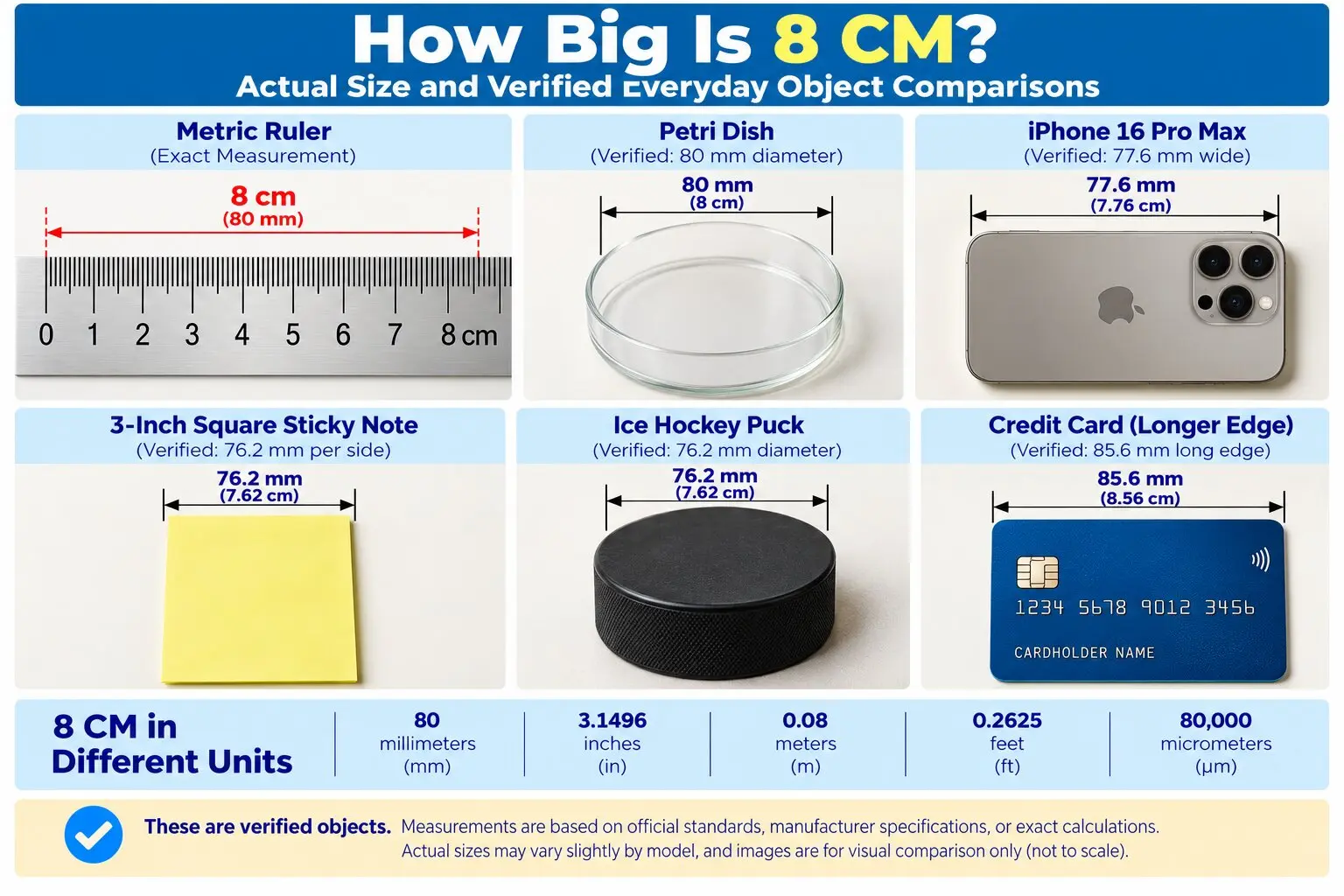
Eight centimeters is slightly longer than 3 inches. It’s close to the width of a large smartphone, slightly wider than a regulation ice hockey puck, and shorter than the long edge of a standard credit card.
Here are six useful measuring references and everyday objects:
| Object or Reference | Documented Measurement | Comparison |
|---|---|---|
| Metric ruler | 80 mm interval | Exact measurement |
| DWK STERIPLAN Petri dish | 80 mm diameter | Manufacturer-specified |
| iPhone 16 Pro Max | 77.6 mm width | 2.4 mm shorter |
| 3-inch square sticky note | 76.2 mm per side | 3.8 mm shorter |
| Regulation ice hockey puck | 76.2 mm diameter | 3.8 mm smaller |
| Standard credit or debit card | 85.60 mm longer edge | 5.6 mm longer |
These are documented measurements, checked against manufacturer specifications, established standards, or official equipment rules. They have not been independently measured for this article, and individual products may vary slightly within manufacturing tolerances.
1. The 8 CM Mark on a Metric Ruler
A metric ruler provides the most reliable way to see eight centimeters.
Find the zero mark and locate the 8 cm mark. The distance between them measures exactly 80 millimeters (8 cm) on an accurately marked ruler.
Each centimeter contains ten millimeters, so eight centimeters contain eighty millimeters.
You can measure this distance horizontally, vertically, or diagonally without changing its length.
Unlike household objects that may vary in size, an accurately marked ruler provides a direct measurement.
2. An 80 MM Petri Dish
Petri dishes are shallow, circular laboratory containers available in different diameters, including 80 mm.
For example, DWK Life Sciences lists its STERIPLAN glass Petri dish, catalog number 237554205, with a specified 80 mm diameter and 15 mm height.
That means the dish measures 8 cm across its circular face, while its height is only 1.5 cm.
Imagine the dish resting flat on a table. Measuring straight across its center provides a useful reference for eight centimeters.
The published 80 mm measurement refers to the dish’s diameter, not its height.
3. The Width of an iPhone 16 Pro Max
The iPhone 16 Pro Max provides a familiar physical comparison close to eight centimeters.
According to Apple’s published dimensions, the device measures 77.6 mm wide (7.76 cm).
That’s just 2.4 mm shorter than 8 cm.
Hold the phone upright and look at its horizontal width from one side to the other. That distance gives you a close idea of eight centimeters.
The phone’s overall height is much greater, so the comparison applies specifically to its width.
Smartphone dimensions vary by model, and a protective case may increase the device’s overall width.
4. A 3-Inch Square Sticky Note
Small square sticky notes are commonly available in a 3 × 3-inch format.
For example, 3M offers Post-it Super Sticky Notes in this specified size.
Since one inch equals exactly 25.4 mm, each nominal side of a 3-inch square measures 76.2 mm (7.62 cm).
That’s only 3.8 mm shorter than eight centimeters.
Place a sticky note flat on a desk and imagine extending one edge by just under 4 mm.
The same note can help you visualize 7 cm using everyday objects, since its side is 6.2 mm longer than seven centimeters but 3.8 mm shorter than eight.
The comparison applies specifically to 3-inch square notes, not every sticky-note format.
5. The Diameter of a Regulation Ice Hockey Puck
A regulation ice hockey puck has a specified diameter of 3 inches, equivalent to 76.2 mm (7.62 cm).
This size is documented in the National Hockey League’s equipment rules.
That makes a regulation puck 3.8 mm smaller in diameter than 8 cm.
Imagine a hockey puck lying flat on a table. Its circular face provides a useful comparison for a distance just under eight centimeters.
The puck’s thickness is a separate measurement and should not be confused with its diameter.
6. The Longer Edge of a Credit Card
A standard credit or debit card follows the ISO/IEC 7810 ID-1 size format.
Its nominal dimensions are 85.60 × 53.98 mm.
The longer edge measures 8.56 cm, making it 5.6 mm longer than eight centimeters.
Hold the card horizontally and look at the distance between its left and right edges. An 8 cm line would stop slightly before the card’s end.
Interestingly, the same card provides a different reference for what 5 cm looks like. Its shorter edge measures approximately 5.4 cm, while its longer edge extends to 8.56 cm.
This makes the card useful for understanding two different measurements using the same familiar object.
How Long Is 8 CM in Inches and Millimeters?
8 cm equals exactly 80 millimeters and approximately 3.1496 inches.
Here are the conversions into other common units:
| Unit | 8 CM Equals |
|---|---|
| Millimeters | 80 mm |
| Inches | Approximately 3.1496 in |
| Meters | 0.08 m |
| Feet | Approximately 0.2625 ft |
| Micrometers | 80,000 µm |
One inch equals exactly 2.54 centimeters, so eight centimeters is slightly longer than three inches.
Three inches equal 76.2 mm, while 3¼ inches equal 82.55 mm. This places eight centimeters between those two measurements.
For a slightly longer comparison, 9 cm extends another 10 mm beyond eight centimeters. Measuring eight centimeters twice along the same straight line gives 16 cm, equivalent to 160 mm.
These relationships make it easier to understand nearby measurements on a metric ruler.
Is 8 CM Bigger Than 3 Inches?
Yes. Eight centimeters is exactly 3.8 mm longer than three inches.
Three inches equal 7.62 cm, while eight centimeters equal 8 cm.
That small difference explains why a 3-inch square sticky note and a regulation hockey puck both provide close comparisons.
You can also explore familiar objects measuring about 3 inches to understand the difference between the two measurements.
For everyday visual estimates, thinking of eight centimeters as slightly more than three inches is helpful.
For cutting materials, choosing replacement parts, or checking dimensions that require a precise fit, use the actual measurement.
How to Measure 8 CM Accurately
A metric ruler is the simplest tool for measuring eight centimeters.
Place the ruler beside the object on a flat surface.
Align the object’s starting edge with the zero mark.
Locate the 8 cm mark, equivalent to 80 mm.
Check whether the opposite edge reaches that position.
You can also reproduce eight centimeters by measuring two consecutive 4 cm sections along the same straight line.
Each section measures 40 mm, giving a combined distance of exactly 80 mm.
For circular objects such as a Petri dish or hockey puck, measure straight across the center to determine the diameter.
A caliper can provide greater precision when measuring small manufactured parts.
Can You Estimate 8 CM Without a Ruler?
Yes. You can estimate eight centimeters using familiar objects with documented dimensions.
The width of an iPhone 16 Pro Max is approximately 7.76 cm, making it one of the closest recognizable references.
One side of a 3-inch square sticky note measures 7.62 cm, while the longer edge of a standard credit card measures 8.56 cm.
An 80 mm Petri dish provides a manufacturer-specified diameter matching the target measurement.
These comparisons help with visual estimation, but they shouldn’t replace a ruler when accuracy matters.
An image displayed on a phone or computer may also appear larger or smaller than eight centimeters because of screen scaling, resolution, and zoom settings.