10 cm (ten centimeters) equals exactly 100 millimeters or approximately 3.94 inches. That’s just 1.6 mm shorter than 4 inches and exactly one-tenth of a meter.
To picture this size, imagine two standard AA batteries placed end to end, four US quarters arranged in a straight row, or a round drink coaster measuring 10 cm across.
Below are everyday examples based on verified published measurements, including official coin specifications, standardized dimensions, and manufacturer documentation. Each comparison identifies whether the object matches 10 cm or is slightly longer or shorter.
How Many Inches Is 10 CM?
10 cm equals approximately 3.937 inches, commonly rounded to 3.94 inches.
To convert centimeters to inches, divide the number of centimeters by 2.54:
10 ÷ 2.54 = 3.937 inches
Since 4 inches equals exactly 10.16 cm, ten centimeters is only 0.16 cm (1.6 mm) shorter than four inches.
Here are the conversions into other common units:
| Unit | 10 CM Equals |
|---|---|
| Millimeters | 100 mm |
| Inches | Approximately 3.937 in |
| Meters | 0.1 m |
| Feet | Approximately 0.3281 ft |
| Yards | Approximately 0.1094 yd |
For everyday visual comparisons, thinking of 10 cm as almost 4 inches is useful. However, the two measurements aren’t interchangeable when precision matters.
What Does 10 CM Look Like? Verified Everyday Objects
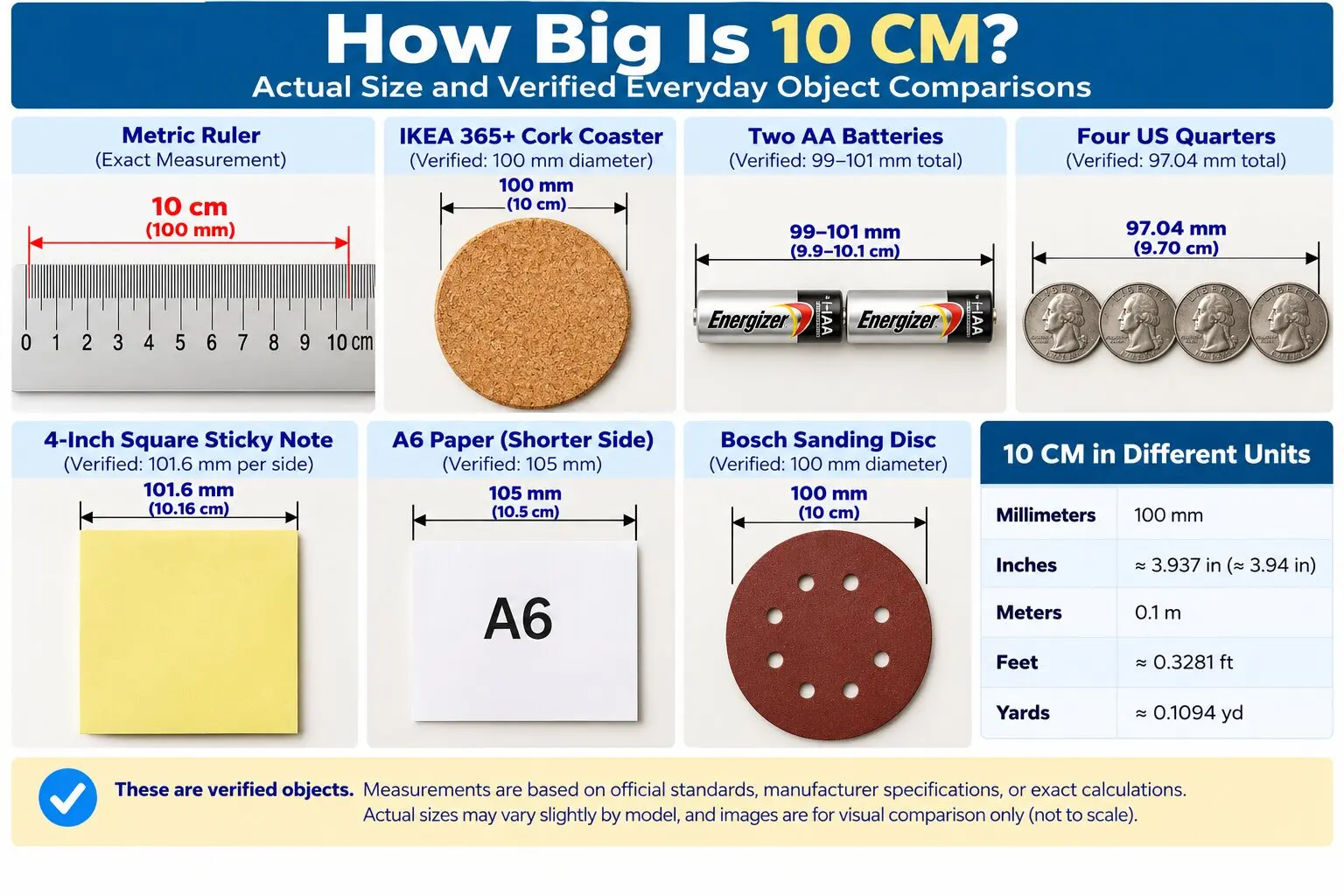
Ten centimeters is a compact measurement close to the diameter of a small drink coaster or the combined length of two AA batteries.
Here are six useful everyday comparisons and one exact measuring reference.
| Object or Reference | Documented Measurement | Comparison |
|---|---|---|
| Metric ruler | 100 mm interval | Exact |
| IKEA 365+ cork coaster | 100 mm diameter | Manufacturer-specified |
| Two AA batteries | 99–101 mm combined length | Very close |
| Four US quarters | 97.04 mm combined diameters | 2.96 mm shorter |
| 4-inch square sticky note | 101.6 mm per side | 1.6 mm longer |
| A6 paper | 105 mm shorter edge | 5 mm longer |
| Bosch R444 sanding disc | 100 mm diameter | Manufacturer-specified |
These comparisons use verified published dimensions from IKEA, Energizer, the United States Mint, Bosch, and established paper-size specifications. The measurements were checked against published sources rather than independently measured from individual objects.
1. The 10 CM Mark on a Metric Ruler
The simplest way to see ten centimeters is to use a metric ruler.
Find the zero mark and locate the 10 cm mark. The distance between them measures exactly 100 millimeters (10 cm) on an accurately marked ruler.
Each centimeter contains ten millimeters, so ten centimeters contain one hundred millimeters.
If your ruler also has inch markings, you’ll notice that the 10 cm mark falls just before the 4-inch mark.
This is the most reliable reference because it shows the measurement directly.
2. An IKEA 365+ Cork Coaster
A round drink coaster provides a useful reference for understanding the size of ten centimeters.
For example, IKEA lists its IKEA 365+ cork coaster with a diameter of 10 cm (100 mm).
Imagine placing the coaster flat on a table and measuring across its circular face through the center. That distance represents its manufacturer-specified diameter.
This is especially useful when trying to understand how wide a 10 cm circular object looks.
IKEA also offers a smaller 9 cm version of its cork coaster. Comparing the two diameters helps illustrate how a 9 cm circular measurement differs from 10 cm by just 10 mm.
The comparison applies to the specified IKEA coaster rather than every drink coaster.
3. Two AA Batteries End to End
Two standard AA batteries provide one of the closest familiar comparisons for a ten-centimeter length.
According to Energizer’s E91 AA battery technical specifications, each battery measures approximately 49.5–50.5 mm long, including its terminals.
Place two batteries end to end in a straight line without leaving a gap.
Their combined length falls between 99 and 101 mm, equivalent to 9.9–10.1 cm.
That’s extremely close to 10 cm.
A single AA battery provides a useful reference for a 5 cm length, while two batteries placed together help you picture twice that distance.
This comparison concerns the batteries’ overall length, not their diameter.
4. Four US Quarters in a Row
A US quarter has an officially specified diameter of 24.26 mm, according to the United States Mint.
Place four quarters edge to edge in a straight row without gaps or overlaps.
Their combined diameters equal:
24.26 × 4 = 97.04 mm
That’s approximately 9.70 cm, making the row only 2.96 mm shorter than ten centimeters.
This provides a practical comparison using coins with officially documented dimensions.
The quarters should be arranged side by side rather than stacked because stacking measures their combined thickness.
5. A 4-Inch Square Sticky Note
Square sticky notes are available in a 4 × 4-inch format.
Since one inch equals exactly 25.4 mm, each side of a 4-inch square measures:
4 × 25.4 = 101.6 mm (10.16 cm)
That’s just 1.6 mm longer than 10 cm.
Picture a square sticky note resting on your desk. Its width or height provides a close visual comparison for ten centimeters.
This measurement applies to a note specified as 4 inches square. Smaller 2-inch and 3-inch sticky notes have different dimensions.
6. The Shorter Edge of A6 Paper
A6 paper follows the ISO A-series paper-size system and has nominal dimensions of 105 × 148 mm.
Its shorter edge measures 105 mm (10.5 cm).
That’s only 5 mm longer than ten centimeters.
If you have an A6 sheet or postcard, look at the distance across its shorter side. That provides a useful reference for visualizing a length slightly greater than 10 cm.
The longer side measures 14.8 cm and is not the dimension being compared.
A6 paper also provides a helpful reference for the difference between 10 cm and 11 cm. Its 105 mm short edge falls exactly halfway between those measurements.
7. A Bosch 100 MM Sanding Disc
Circular sanding discs are manufactured in several diameters, including 100 mm.
For example, Bosch Professional lists its R444 Expert for Metal sanding disc with a specified 100 mm outer diameter and a 16 mm center bore.
That means the disc measures 10 cm across its circular face according to the published product specifications.
Its center hole is much smaller and shouldn’t be confused with its outside diameter.
This is a useful workshop example for understanding a ten-centimeter circular measurement.
The comparison applies to the specified Bosch disc size, not every sanding disc.
Is 10 CM the Same as 4 Inches?
Not exactly. Ten centimeters is 1.6 mm shorter than four inches.
Here’s the difference:
10 cm = 100 mm
4 inches = 101.6 mm
Difference = 1.6 mm
The two measurements look almost identical when placed side by side.
You can explore familiar objects measuring about 4 inches for additional real-life comparisons.
For approximate measurements, treating 10 cm as nearly 4 inches is reasonable. For cutting materials, fitting parts, or checking product dimensions, use the correct value.
How Wide or Tall Is 10 CM?
10 cm is exactly 100 mm wide or tall, depending on the direction being measured.
The distance remains the same whether it describes an object’s height, width, length, or diameter.
For a width comparison, picture the circular diameter of the IKEA 365+ coaster.
For a vertical length comparison, imagine two AA batteries standing end to end.
When reading product specifications, check which dimension is listed as 10 cm. A 10 cm-wide object isn’t necessarily 10 cm tall or deep.
How to Measure 10 CM Accurately
A metric ruler provides the easiest way to measure ten centimeters.
Place the ruler beside the object on a flat surface.
Align the object’s starting edge with the zero mark.
Locate the 10 cm mark, equivalent to 100 mm.
Check whether the opposite edge reaches that position.
You can also reproduce ten centimeters by measuring two consecutive 5 cm sections.
Each section measures 50 mm, giving a total of 100 mm.
For a longer measurement, repeat the 10 cm distance twice along the same straight line to reach 20 cm (200 mm).
For round objects such as coasters or sanding discs, measure straight across the center to determine their diameter.
A caliper is useful when greater precision is required.
Can You Estimate 10 CM Without a Ruler?
Yes. Familiar objects with documented dimensions can help you estimate ten centimeters.
Two AA batteries placed end to end provide one of the closest practical references, with a combined length of approximately 9.9–10.1 cm.
Four US quarters arranged in a straight row span approximately 9.7 cm.
A 4-inch square sticky note measures 10.16 cm along each side, while the shorter edge of A6 paper measures 10.5 cm.
An IKEA 365+ cork coaster with a published 10 cm diameter is another useful reference.
These comparisons help with visual estimation, but they shouldn’t replace measuring tools when an exact fit matters.
Also, an image displayed on a phone or computer may not show ten centimeters at its true physical size because screen zoom and scaling can affect its appearance.