
One and a half inches (1.5 inches) equal exactly 3.81 centimeters (cm) or 38.1 millimeters (mm). That’s halfway between one and two inches on a ruler.
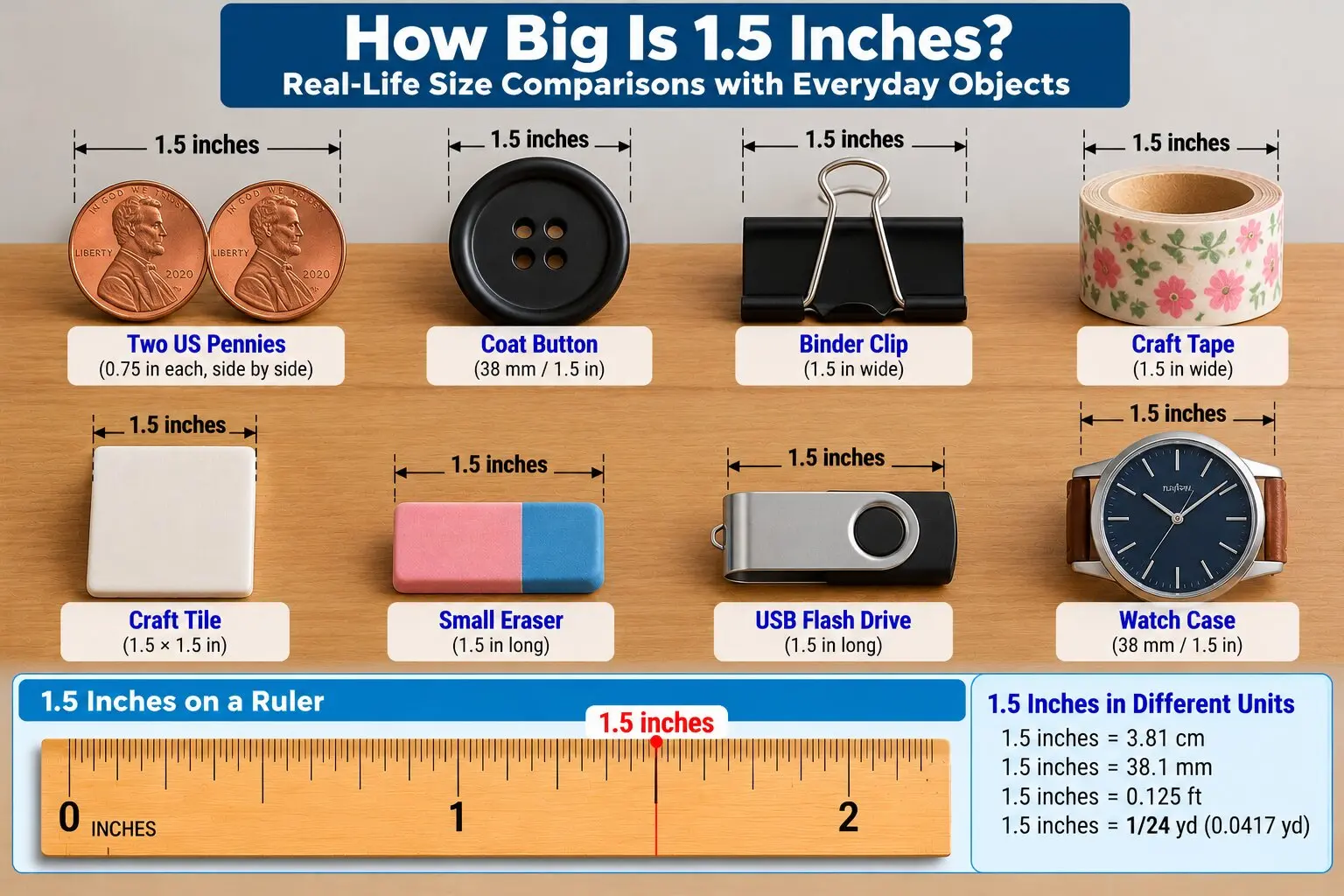
To picture this length, imagine two US pennies placed edge to edge or a large coat button measuring approximately 38 mm across.
Knowing what 1.5 inches looks like can help when comparing small accessories, checking product dimensions, choosing craft supplies, or estimating measurements without a ruler.
Below are eight everyday objects and size references that help you visualize one and a half inches, including their exact, stated, or approximate dimensions.
What Does 1.5 Inches Look Like in Real Life?
1.5 inches measure 3.81 cm, making the distance slightly shorter than four centimeters.
On a standard inch ruler, the measurement falls exactly halfway between the 1-inch and 2-inch marks.
Some familiar size comparisons include:
Two US pennies: Each measures 0.75 inches in diameter, so two placed edge to edge span 1.5 inches by their specified dimensions.
Large coat button: A 38 mm button measures approximately 1.496 inches across.
1.5-inch binder clip: A binder clip specifically sold in this width provides an office reference.
1.5-inch-wide craft tape: Tape labeled with this width provides a convenient straight measurement.
1.5-inch square craft tile: Each side measures 1.5 inches by its stated dimensions.
These objects help you understand one and a half inches as a straight length, width, or diameter.
For perspective, 1.5 inches are half an inch longer than 1 inch and half an inch shorter than 2 inches.
How Long Is 1.5 Inches in CM, MM, and Feet?
One and a half inches equal exactly 3.81 centimeters or 38.1 millimeters.
Since one inch is defined as 25.4 mm, multiplying that value by 1.5 gives the exact metric equivalent.
| Unit | Equivalent |
|---|---|
| Centimeters | 3.81 cm |
| Millimeters | 38.1 mm |
| Meters | 0.0381 m |
| Feet | 1/8 foot (0.125 ft) |
| Yards | 1/24 yard (approximately 0.04167 yd) |
| Half of 1.5 inches | 0.75 inches (1.905 cm) |
| Double 1.5 inches | 3 inches (7.62 cm) |
The metric conversions and fractions are exact, while the displayed decimal value for yards is rounded.
One and a half inches are exactly half the length of three inches. For a larger comparison, explore our guide to objects that are 3 inches long.
8 Everyday Objects That Are About 1.5 Inches Long
The following examples include coins with specified dimensions, clothing accessories, stationery, and craft supplies available in one-and-a-half-inch sizes.
Not every household product has a universal measurement, so each description identifies which part of the object matches the target length.
1. Two US Pennies Side by Side
A standard US penny has a specified diameter of 0.75 inches (19.05 mm).
When two pennies are placed flat, edge to edge in a straight line, their combined nominal width measures 1.5 inches (38.1 mm).
This makes two pennies one of the clearest physical references for visualizing one and a half inches.
The comparison uses the diameter of each coin, not its thickness. Stacking two pennies vertically would produce a much smaller measurement.
For the most useful comparison, place the coins on a flat surface with their edges touching and measure straight across both.
2. Large Coat Button (38 mm)
Oversized coat buttons are available in diameters close to 38 millimeters.
A button measuring 38 mm across is approximately 1.496 inches wide, making it very close to one and a half inches.
These larger buttons may be found on coats, jackets, decorative clothing, and certain sewing projects.
The measurement refers to the diameter across the center of the button.
Ordinary dress-shirt buttons are typically much smaller, so choose a large coat button with a verified diameter rather than assuming any clothing button measures 1.5 inches.
3. 1.5-Inch Binder Clip
Binder clips are available in different sizes, including models with a specified width of 1.5 inches.
The measurement refers to the main metal body across the edge that grips the paper, not the height of its wire handles.
This provides a familiar office reference for comparing small objects, stationery, or craft materials.
Binder clips are commonly used in schools, homes, and offices for holding groups of papers together.
However, clip dimensions vary by product. Check that the binder clip is specifically labeled as 1.5 inches wide before using it as a reference.
4. 1.5-Inch-Wide Craft Tape
Craft and specialty adhesive tapes are available in different widths, including versions measuring 1.5 inches.
A tape roll labeled with a 1.5-inch tape width provides a useful reference for visualizing 38.1 mm.
The measurement refers to the width of the tape strip, not the diameter of the complete roll.
Such tapes may be used for decorating, packaging, painting, and other craft activities.
To compare the size, place a short piece of tape on a flat surface and look across its width.
Check the packaging because ordinary adhesive tapes are manufactured in several narrower and wider sizes.
5. 1.5-Inch Square Craft Tile
Miniature craft tiles and mosaic materials are available in different sizes, including products with stated 1.5 × 1.5-inch dimensions.
Each side of a tile in this format measures approximately 3.81 cm, corresponding to its specified size.
Its square shape helps you visualize one and a half inches horizontally and vertically.
These small tiles may be used for mosaic artwork, decorations, craft projects, or sample displays.
However, tile dimensions vary by manufacturer. Some products also have slightly different actual and nominal measurements.
Use a tile specifically labeled or verified as 1.5 inches rather than assuming all miniature craft tiles share this dimension.
6. Small Eraser
Small rectangular erasers are manufactured in different lengths, including models measuring approximately 1.5 inches.
An eraser with a verified 38.1 mm length provides a straightforward reference for visualizing a short rectangular object.
Erasers are commonly used in schools, offices, and art projects, making them familiar stationery items.
However, there is no universal size for small erasers.
Some measure less than an inch, while others are substantially longer.
Check the particular eraser’s dimensions before using it as a reliable one-and-a-half-inch reference.
7. Compact USB Flash Drive
USB flash drives are available in many shapes and sizes, including compact models measuring approximately 1.5 inches in overall length.
A flash drive with a verified length of 38.1 mm can provide a familiar technology-related comparison.
These devices are commonly used for storing and transferring digital files.
However, USB flash drives vary considerably in physical size, and some miniature models are much shorter than 1.5 inches.
Also, manufacturers may measure the drive with or without an extended USB connector.
Use the published overall dimensions of the specific model rather than assuming all compact flash drives have the same length.
8. Watch Case Measuring Approximately 38 mm
Some wristwatches have a case width of approximately 38 millimeters.
A 38 mm case measures about 1.496 inches, making it very close to one and a half inches.
The case is the outer housing surrounding the watch dial or display.
This provides a useful circular reference for visualizing the size of small accessories.
However, the visible dial diameter may be smaller than the case width, and crown or button protrusions can increase the watch’s overall width.
Check the manufacturer’s stated case dimensions before using a watch as a 1.5-inch reference.
Which Everyday Objects Are Closest to Exactly 1.5 Inches?
Some objects have defined measurements, while others are available in approximate or manufacturer-specific sizes.
| Object | Length or dimension | Reliability |
|---|---|---|
| Two US pennies side by side | 1.5 inches across, nominal | High — specified coin diameters |
| Large 38 mm coat button | Approximately 1.496 inches | Very close |
| 1.5-inch binder clip | 1.5-inch stated body width | Check product |
| 1.5-inch-wide craft tape | 1.5-inch stated width | Check product |
| 1.5-inch square craft tile | 1.5-inch nominal side | Check product |
| Small rectangular eraser | Varies by model | Verify length |
| Compact USB flash drive | Varies by model | Verify overall length |
| 38 mm watch case | Approximately 1.496 inches | Check sizing method |
For a quick physical comparison, two standard US pennies placed side by side provide a particularly useful reference.
A large 38 mm coat button or verified 1.5-inch binder clip can also help you visualize this small measurement.
How to Measure 1.5 Inches Without a Ruler
If you don’t have a ruler nearby, you can estimate one and a half inches using familiar objects with known dimensions.
1. Use two US pennies. Place them flat, edge to edge in a straight line. Their combined nominal diameter measures 1.5 inches.
2. Compare with a 38 mm coat button. Its diameter is very close to the target length.
3. Use a verified 1.5-inch binder clip. The clip’s stated metal body width provides another reference.
4. Compare with 1.5-inch-wide craft tape. A piece of tape with a verified width can help estimate the distance.
5. Use a measured personal reference. Measure a small, familiar object once and remember its dimensions for future comparisons.
These techniques are useful for rough everyday estimates.
Avoid assuming that ordinary bottle caps, shirt buttons, random coin stacks, or thumb widths measure exactly 1.5 inches.
For precise craft work, hardware fitting, or other tasks requiring accuracy, use a ruler or caliper.
How to Find 1.5 Inches on a Ruler
One and a half inches are located exactly halfway between the 1-inch and 2-inch marks on a standard ruler.
To find the measurement:
Align the object’s starting edge with the ruler’s zero mark.
Find the number 1 on the inch scale.
Locate the longer halfway mark between 1 and 2.
Check whether the object’s opposite end reaches that point.
This mark represents 1½ inches, which is the same as 1 inch plus ½ inch.
On a metric ruler, one and a half inches equal exactly 38.1 mm. Locate the 38 mm mark and move another 0.1 mm.
Most ordinary rulers cannot measure tenths of a millimeter precisely, so a caliper is more suitable when that level of accuracy is needed.