1 cm (one centimeter) equals exactly 10 millimeters or approximately 0.39 inches. That’s slightly smaller than half an inch.
To see what 1 cm actually looks like, examine the distance between the 0 and 1 cm marks on a metric ruler. You can also picture a round craft bead measuring 10 mm across or a miniature die with 10 mm sides.
The examples below use published product specifications, standardized measurements, and clearly identified estimates. They explain which objects have a documented 1 cm dimension and which are only close comparisons.
What Does 1 CM Actually Look Like?
One centimeter is a straight-line distance of exactly 10 millimeters.
On a metric ruler, the distance between two consecutive centimeter marks is 1 cm. That distance is divided into ten smaller millimeter intervals.
A 10 mm round bead provides a comparison for diameter, while a miniature die measuring 10 × 10 × 10 mm shows how one centimeter looks as the width, height, and depth of a small cube.
For an accurate representation of its actual physical size, use a metric ruler. An image displayed on a phone or computer may appear larger or smaller depending on screen settings and zoom.
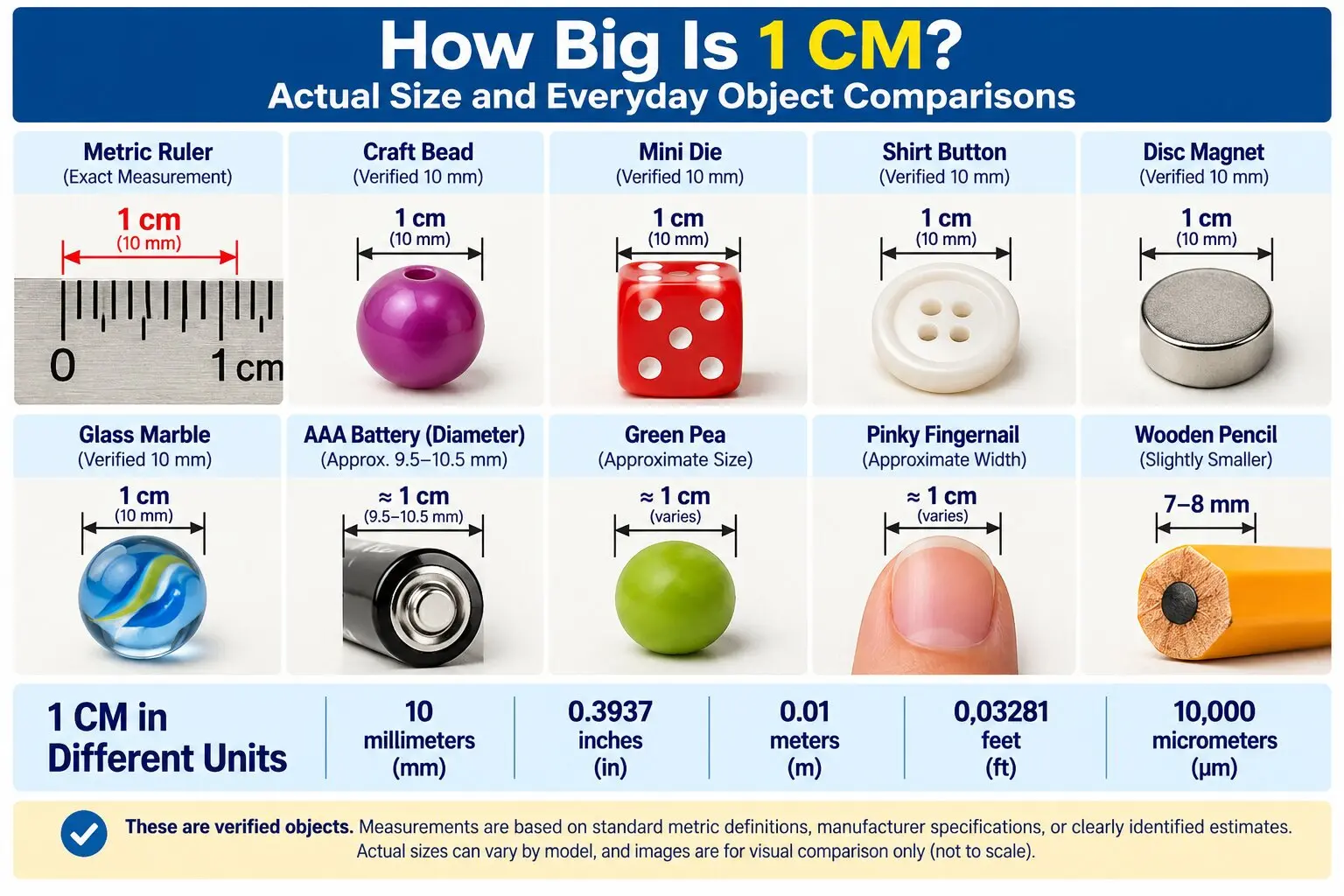
Everyday Objects About 1 CM in Size
Several small manufactured objects are sold with dimensions of 10 mm, equivalent to one centimeter. Others, such as batteries, have dimensions close to this measurement.
The comparisons below distinguish manufacturer-specified sizes from approximate everyday references.
| Object or Reference | Documented Measurement | Comparison |
|---|---|---|
| Metric ruler | 10 mm interval | Exact |
| BeadTin round craft bead | 10 mm diameter | Manufacturer-specified |
| Miniature six-sided die | 10 × 10 × 10 mm | Published product size |
| Small shirt button | 10 mm diameter | Specified button size |
| Round disc magnet | 10 mm diameter | Specified product size |
| Miniature glass marble | 10 mm nominal diameter | Approximate due to tolerances |
| AAA battery | 9.5–10.5 mm body diameter | Close comparison |
These are documented dimensions and standardized references, not objects independently measured for this article. The published measurements apply to the specified sizes, not every item in the same category.
1. The 1 CM Mark on a Metric Ruler
The most reliable way to see one centimeter is to look at a metric ruler.
Find the zero mark and then locate the 1 cm mark. The distance between them is exactly 10 millimeters (1 cm) on an accurately marked ruler.
You can also count the ten small millimeter divisions between those marks.
Unlike an estimated household comparison, the ruler shows the measurement directly.
2. A 10 MM Round Craft Bead
Small plastic craft beads are manufactured in different sizes, including a diameter of 10 mm (1 cm).
For example, BeadTin lists its white matte round plastic craft beads at 10 mm in diameter, with a 1 mm hole through the center.
The 10 mm measurement refers to the bead’s outer diameter, not the hole.
Place a bead of this specified size beside a ruler to visualize a centimeter across a small round object.
3. A Miniature Six-Sided Die
Miniature gaming dice are available with stated dimensions of 10 × 10 × 10 mm.
For example, The Game Crafter lists miniature six-sided dice in this size.
Each dimension of the small cube measures 1 cm according to the product specification.
This makes a miniature die a useful reference for understanding not just the length of one centimeter, but also its height and width.
Regular board-game dice are often larger, so this comparison applies specifically to miniature 10 mm dice.
4. A Small Shirt Button
Some small round clothing buttons have a specified diameter of 10 mm (1 cm).
For example, Augsburger Knopffabrik documents a button-size convention in which size 16 corresponds to a 10 mm diameter.
Measuring straight across the center of a button of this size gives a one-centimeter reference.
However, shirt buttons vary in size. Larger or smaller buttons should not be assumed to measure exactly 1 cm.
Source: Augsburger Knopffabrik’s published button sizing information.
5. A 10 MM Round Disc Magnet
Small round disc magnets are available with a diameter of 10 mm.
A magnet specified as 10 mm in diameter and 2 mm thick has a circular face measuring one centimeter across, while its thickness is only 0.2 cm.
This is useful for understanding how an object can have one dimension equal to 1 cm while its other dimensions are smaller.
Check the particular magnet’s specifications before using it as an exact comparison.
6. A Miniature Glass Marble
Miniature glass marbles are available in nominal diameters of 10 mm.
Manufacturers such as SDBALLS list 10 mm among their available marble sizes, although production tolerances can affect the actual diameter.
Imagine a small glass sphere measuring approximately one centimeter across.
Ordinary toy marbles can be considerably larger, so use the stated product size rather than assuming all marbles measure 1 cm.
7. The Diameter of an AAA Battery
An AAA battery has a body diameter close to one centimeter.
Energizer’s published AAA battery specifications show an allowable diameter range of approximately 9.5–10.5 mm.
That makes the circular end of an AAA battery a useful reference for understanding a 10 mm distance.
The comparison refers only to the battery’s diameter, not its entire length, which is much greater.
Other Small Objects Close to 1 CM
Some everyday objects can help with a rough visual estimate, although their sizes are not fixed:
Small green pea: Some peas may be close to 10 mm across, depending on their variety and size.
Pinky fingernail: The width of a person’s little fingernail may be near 1 cm, but this varies by individual.
Wooden pencil: Many ordinary pencils have a body thickness around 7–8 mm, making them slightly narrower than 1 cm.
These examples are for approximate visualization only, not precise measurements.
How Big Is 1 CM in Inches and Millimeters?
1 cm equals exactly 10 mm and approximately 0.3937 inches.
Here are the conversions into other common units:
| Unit | 1 CM Equals |
|---|---|
| Millimeters | 10 mm |
| Inches | Approximately 0.3937 in |
| Meters | 0.01 m |
| Feet | Approximately 0.03281 ft |
| Micrometers | 10,000 µm |
One centimeter is smaller than half an inch.
Since one inch equals exactly 2.54 cm, half an inch equals 1.27 cm.
That means half an inch is 2.7 mm longer than one centimeter.
To understand how small one centimeter is, compare it with slightly larger measurements. 2 cm is twice as long as 1 cm, 3 cm is three times as long, and 5 centimeters is five times as long, or approximately 1.97 inches. Comparing these lengths side by side on a metric ruler makes their differences easier to see.
How to Measure 1 CM Accurately
A metric ruler provides a simple way to measure one centimeter.
Place the ruler next to the object on a flat surface.
Align one edge of the object with the ruler’s zero mark.
Identify where the opposite edge falls.
If the opposite edge reaches the 1 cm mark, the measured distance equals 10 mm.
For very small circular objects, such as beads, buttons, and magnets, a caliper can provide a more precise diameter measurement.
Always ensure the measuring tool is properly aligned with the dimension being checked.
Can You Estimate 1 CM Without a Ruler?
Yes, but the result depends on how reliable your reference is.
A craft bead specified as 10 mm in diameter, a miniature 10 mm die, or a small button with a documented diameter can provide a useful physical comparison.
The circular end of an AAA battery is another convenient reference because its body diameter is close to 10 mm.
Natural objects such as peas and fingernails are less dependable because they vary in size.
An ordinary image on a phone or computer should not be used as an exact 1 cm measuring reference. Screen resolution, display scaling, and zoom can change its apparent physical size.
For accurate measurements, use a metric ruler or caliper.