3 cm (three centimeters) equals exactly 30 millimeters or approximately 1.18 inches. That’s 4.6 mm longer than one inch and almost the same diameter as a US half-dollar coin.
To see what 3 cm actually looks like, find the distance between the 0 and 3 cm marks on a metric ruler. You can also picture a 30 mm cabinet knob, a large clothing button, or a round disc magnet.
The examples below are based on official measurements and published manufacturer or retailer specifications. Each comparison identifies which objects have a stated 30 mm dimension and which are slightly larger or smaller.
What Does 3 CM Look Like? Everyday Objects
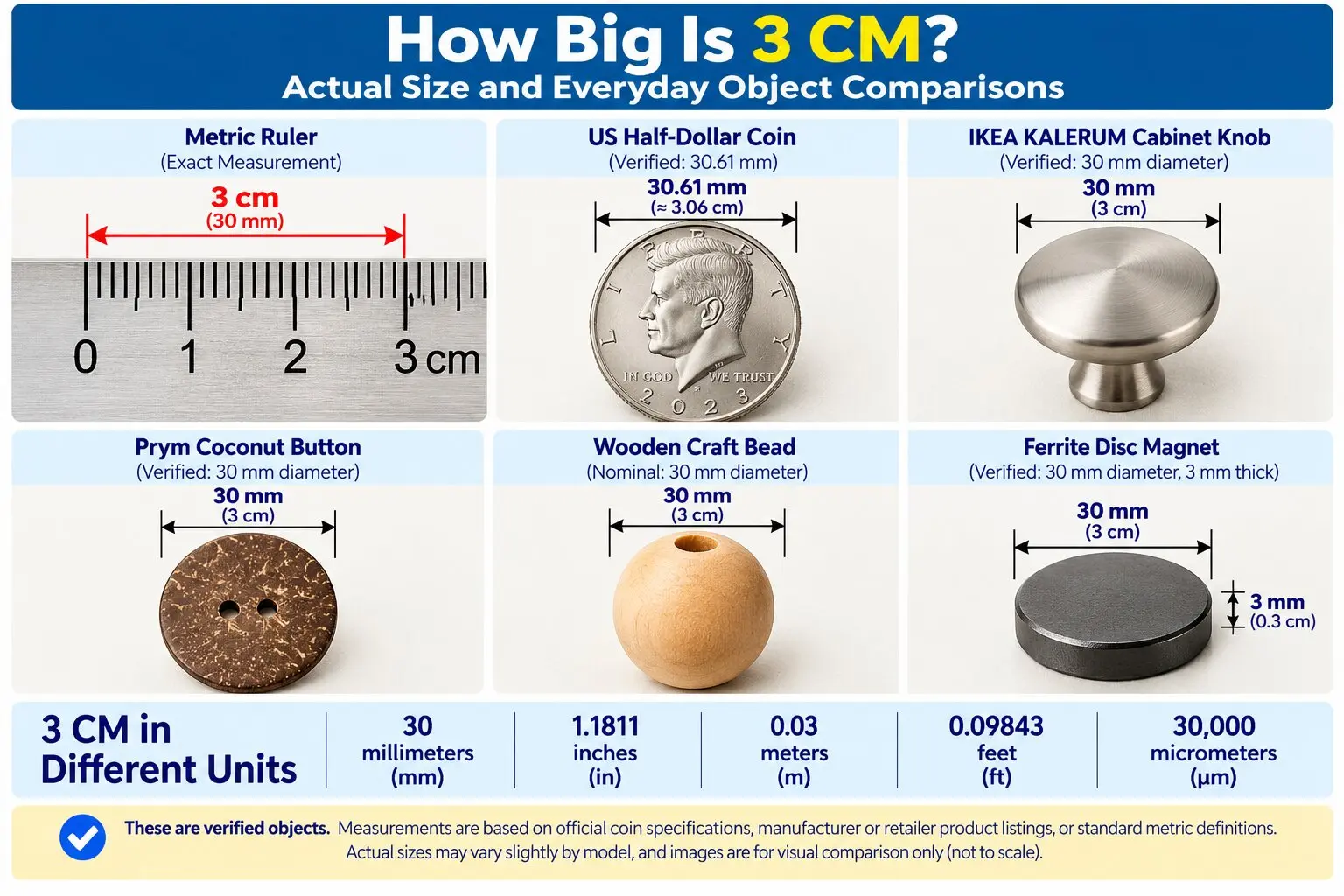
Three centimeters is a little longer than one inch. It’s close to the diameter of a US half-dollar coin or a small round cabinet knob.
Here are five useful objects and a direct measuring reference:
| Object or Reference | Documented Measurement | Comparison |
|---|---|---|
| Metric ruler | 30 mm interval | Exact measurement |
| US half-dollar coin | 30.61 mm diameter | 0.61 mm larger |
| IKEA KALERUM cabinet knob | 30 mm diameter | Manufacturer-specified |
| Prym coconut button | 30 mm diameter | Manufacturer-specified |
| 30 mm wooden craft bead | Nominal 30 mm diameter | Specified size category |
| Ferrite disc magnet | 30 mm diameter, 3 mm thick | Retailer-specified |
These dimensions are supported by measurement standards or published product information. They have not been independently measured for this article, and manufactured objects may vary slightly within production tolerances.
1. The 3 CM Mark on a Metric Ruler
The most reliable way to see three centimeters is to use a metric ruler.
Find the zero mark and locate the 3 cm mark. The distance between them measures exactly 30 millimeters (3 cm) on an accurately marked ruler.
Each centimeter contains ten millimeter intervals, so three centimeters contain thirty.
You can measure this distance horizontally or vertically without changing its length.
For small items such as coins, buttons, and beads, a ruler is more dependable than estimating their dimensions by eye.
2. The Diameter of a US Half-Dollar Coin
A US half-dollar coin measures 30.61 mm (3.061 cm) in diameter, according to the United States Mint.
That makes it just 0.61 mm larger than 3 cm.
Place the coin flat on a table and look at its circular face. Measuring straight across the center gives you a useful reference for a distance slightly greater than three centimeters.
For comparison, a US quarter measures 24.26 mm across, making it considerably smaller than a half-dollar.
Because these coin dimensions are officially documented, the half-dollar is one of the most dependable familiar comparisons.
3. An IKEA KALERUM Cabinet Knob
The IKEA KALERUM cabinet knob has a manufacturer-listed diameter of 30 mm (3 cm).
IKEA also specifies a depth of 25 mm, showing that the knob’s diameter and depth are different measurements.
Imagine looking directly at the circular front of the knob. The 30 mm diameter provides a useful physical comparison for three centimeters.
The published measurement applies to this particular KALERUM model, not every cabinet knob.
4. A 30 MM Coconut Clothing Button
Large clothing and decorative buttons are available in a specified 30 mm diameter, equivalent to 3 cm.
For example, Prym lists a coconut two-hole button measuring 30 mm across.
This provides a familiar reference when sewing, replacing buttons, or choosing decorative fasteners.
The measurement refers to the button’s overall diameter, not its thickness or the distance between the sewing holes.
Buttons come in many sizes, so only a button with a stated 30 mm diameter represents this comparison.
5. A 30 MM Wooden Craft Bead
Round wooden craft beads and balls are sold in different sizes, including a nominal 30 mm diameter (3 cm).
A bead of this specified size provides a useful spherical reference for the measurement.
Imagine placing the bead beside a metric ruler and comparing its widest point with the distance between the 0 and 3 cm marks.
Because wood products may have small manufacturing variations, a 30 mm label describes the stated product size rather than guaranteeing that every individual bead measures exactly 30 mm.
Check the particular bead’s listed dimensions when an exact fit matters.
6. A 30 MM Round Disc Magnet
Ferrite disc magnets are available with a specified diameter of 30 mm.
For example, CCTV Master lists a ferrite disc magnet measuring 30 mm in diameter and 3 mm thick.
Viewed from above, its circular face measures 3 cm across according to the published product dimensions.
However, its thickness is only 0.3 cm.
This example is useful because it demonstrates how an object can measure 3 cm across while being considerably thinner.
How Much Is 3 CM in Inches and Millimeters?
3 cm equals exactly 30 mm and approximately 1.1811 inches.
Here are the conversions into other common units:
| Unit | 3 CM Equals |
|---|---|
| Millimeters | 30 mm |
| Inches | Approximately 1.1811 in |
| Meters | 0.03 m |
| Feet | Approximately 0.09843 ft |
| Micrometers | 30,000 µm |
Since one inch equals exactly 2.54 centimeters, 3 cm is 4.6 millimeters longer than one inch.
To understand how big 3 cm is compared with nearby measurements, 1 centimeter is one-third as long, while 2 centimeters is one centimeter shorter. 4 centimeters is one centimeter longer than 3 cm, and five cm is two centimeters longer. Comparing these distances side by side on a metric ruler makes their differences easier to see.
Is 3 CM Bigger Than 1 Inch?
Yes. Three centimeters is approximately 18% longer than one inch.
One inch measures exactly 25.4 mm, while three centimeters measure 30 mm.
The difference is 4.6 mm, which may seem small but can matter when selecting buttons, craft supplies, watch accessories, or small hardware.
For an accurate comparison, use a ruler with both metric and imperial markings.
An object measuring 3 cm should not be treated as interchangeable with an object measuring exactly one inch when precise fitting is required.
How to Measure 3 CM Accurately
A metric ruler is the easiest way to measure three centimeters.
Place the ruler beside the object on a flat surface.
Align one edge of the object with the zero mark.
Locate the 3 cm mark, equivalent to 30 mm.
Check whether the opposite edge reaches that mark.
For circular objects such as coins, buttons, and beads, measure straight across the center to determine their diameter.
A caliper is useful when greater precision is required, particularly for small hardware or items with manufacturing tolerances.
Can You Estimate 3 CM Without a Ruler?
Yes. You can estimate three centimeters using objects with documented dimensions.
A US half-dollar coin is one of the closest familiar references because its diameter is only 0.61 mm larger than 3 cm.
A specified 30 mm cabinet knob, clothing button, or disc magnet can also help you picture this size.
However, these physical comparisons should not replace measuring tools when accuracy matters.
Avoid relying on random bottle caps, grapes, fingers, or other objects whose dimensions vary considerably.
An image displayed on a phone or computer may also appear larger or smaller than its intended size because of screen scaling and zoom settings.